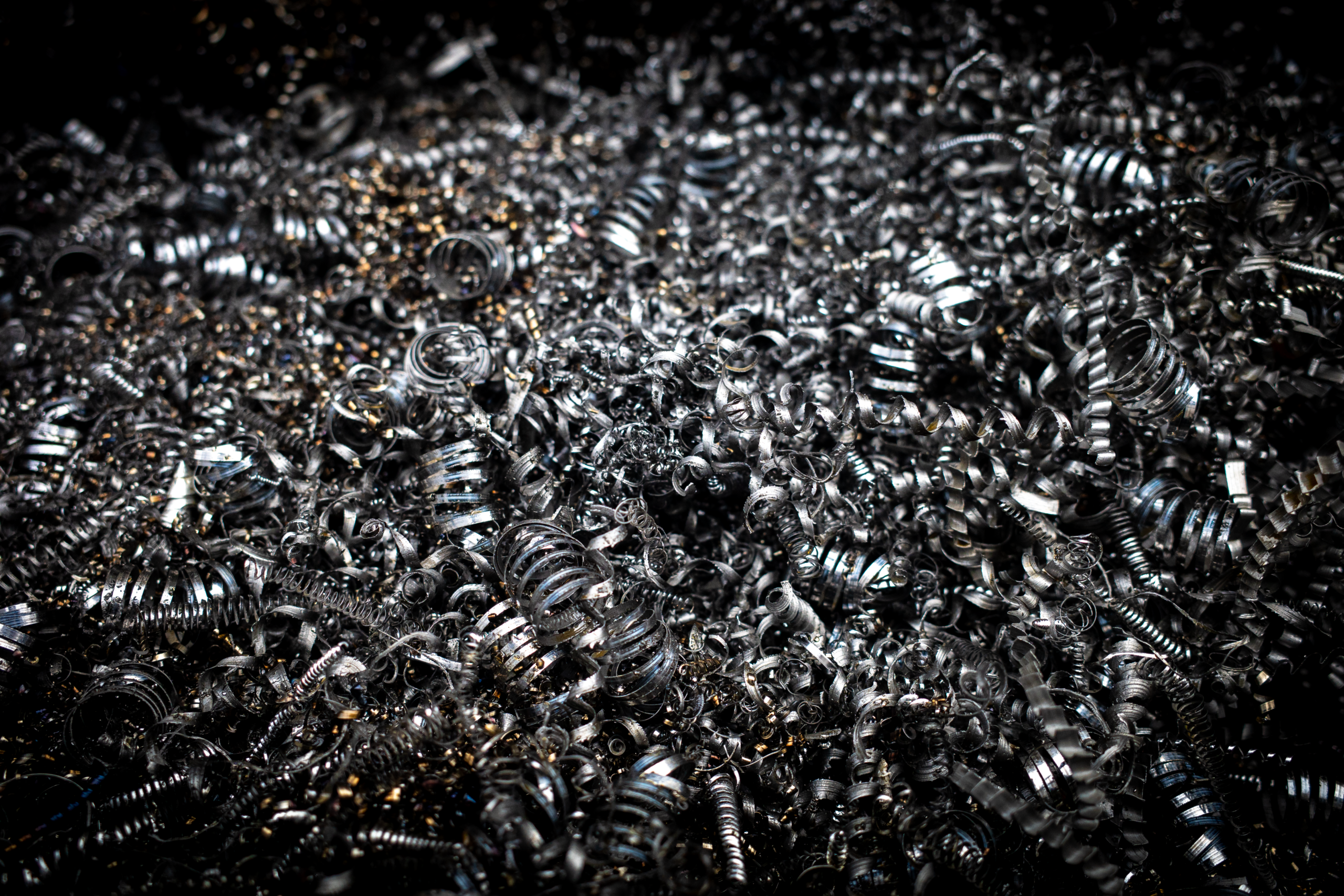

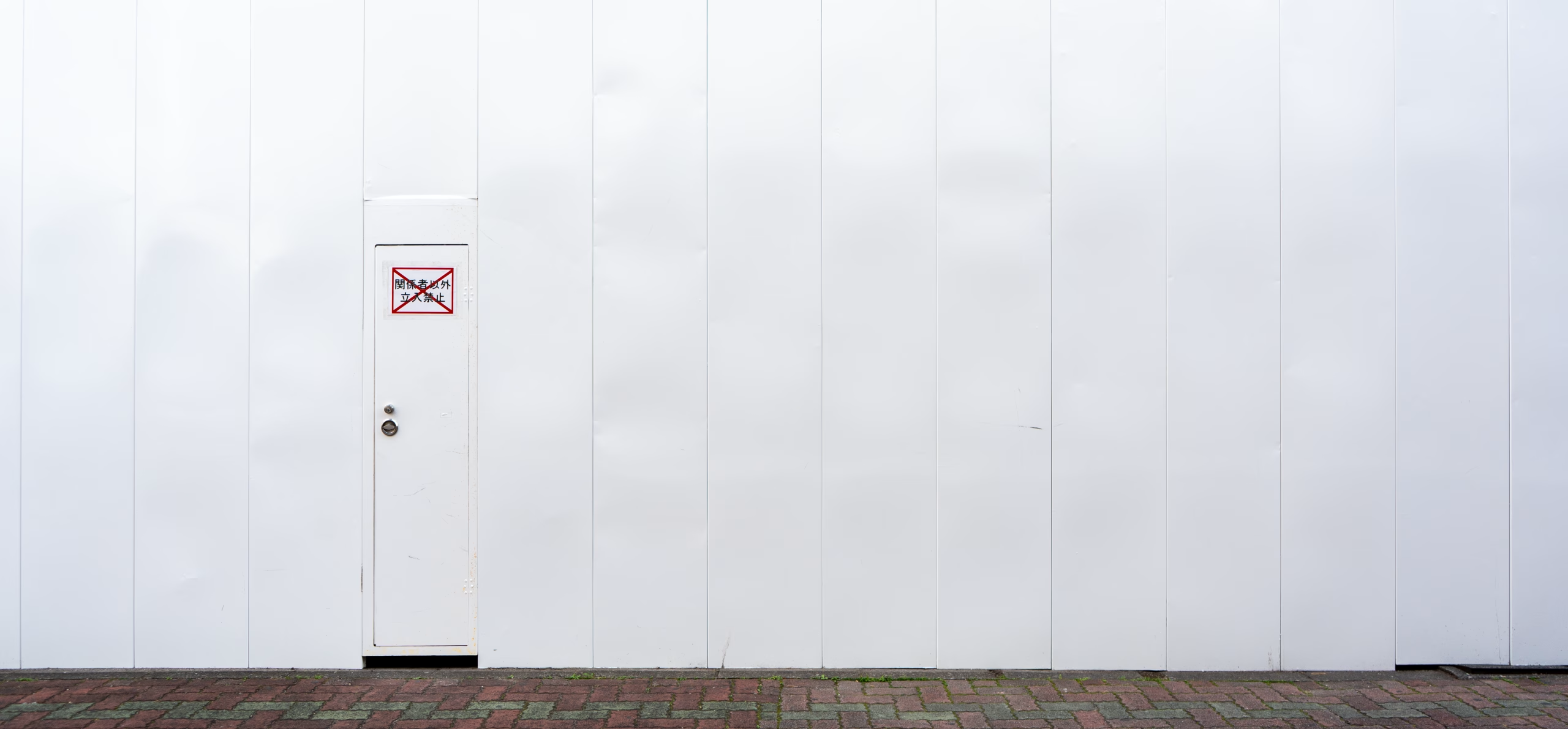
Main Venue: Old Kobayashi Pharmacy
1-20-9 Tateishi, Katsushika, Tokyo
Term I 27 January-1 February 2026 (Research and Performance)
Term II 17-23 February 2026 (Research, Exhibit, and Performance)
Term III 24-26 April 2026 (Exhibit and Workshop)
Organized by igkas project
Supported by Arts Council Tokyo (Startup Grant)

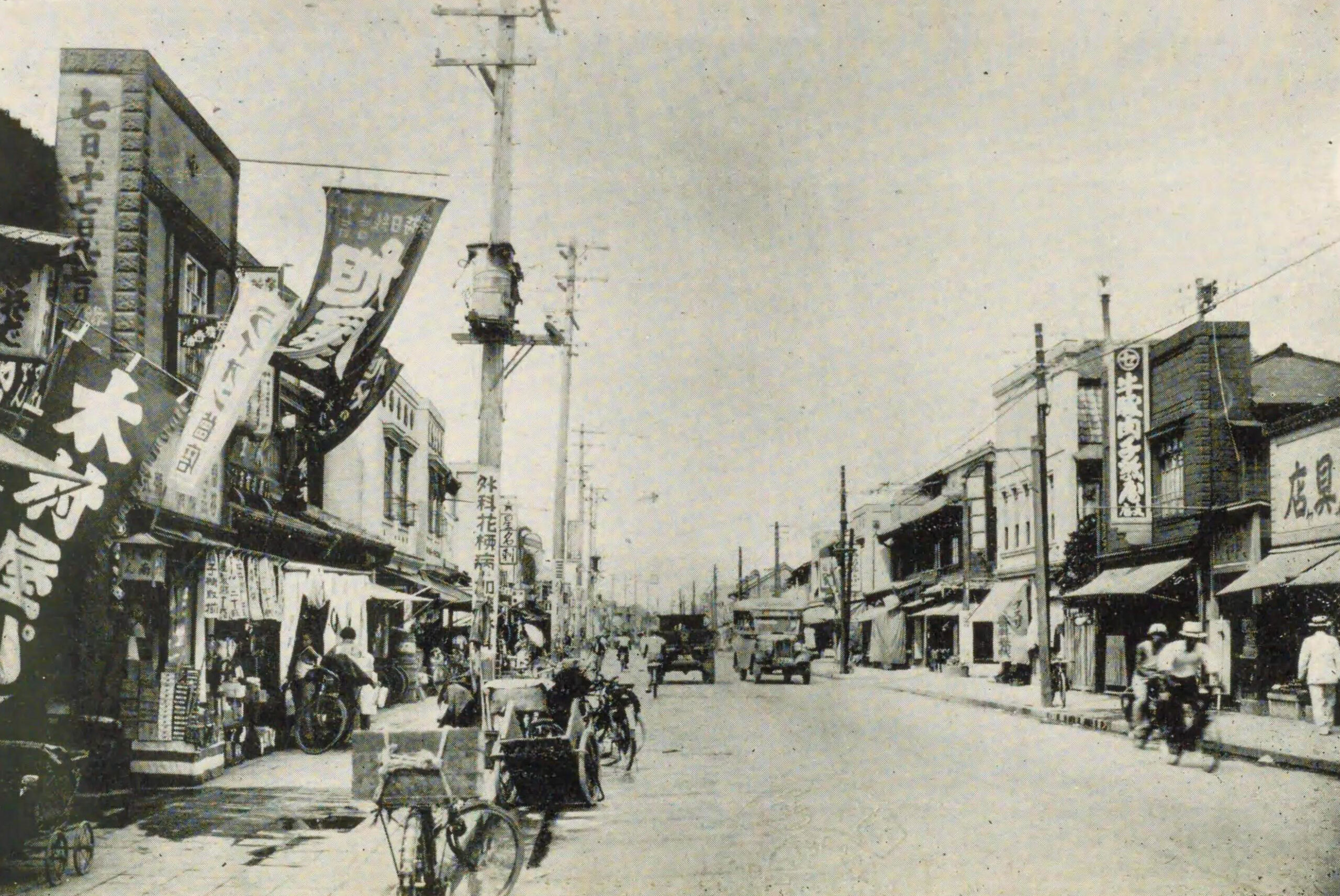
Source: 東京市葛飾区編『葛飾区史』(東京市葛飾区, 1936年).
The sum of the necessary labor and the surplus labor, or the sum of the periods of time in which the worker replaces the value of his labor-power and produces the surplus value, constitutes the absolute magnitude of his labor-time, i.e., the working day.
(Karl Marx, Das Kapital: Kritik der politischen Ökonomie, Bd. I, Dritter Abschnitt, in Karl Marx-Friedrich Engels Werke, ed. Institut für Marxismus-Leninismus beim Zentralkomitee der SED (Berlin, DDR: Dietz Verlag, 1974 [1867]), S. 244.)
I usually worked overtime from five-thirty in the evening until eight, and then headed to the club office. When I arrived there, a crowd of young people had already gathered, printing materials for things like travel groups, haiku gatherings, and reading circles. I joined them—helping with the printing and taking part in meetings—and before I knew it, it was already midnight. I hurried to catch the red train home, went to bed around one-thirty, and the next morning I was shaken awake again at five-thirty.
(Masao Sugiura, ed., Senjichu Insatsu Rodosha no Tatakai no Kiroku (Tokyo: Shuppanko Kurabu, 1964), 72-73.)
Synopsis
In twentieth-century Japan, the development of the manufacturing industry in downtown Tokyo accelerated the nation’s economic growth and helped fuel the pursuit of material abundance among the general populace in consumer society. As desires for economic prosperity swelled in society at large, however, factory workers in the downtown area nurtured alternative cultures of their own—cultures that cannot be measured by the yardstick of material wealth. This project highlights the unique cultures of industrial workers and their families, who struggled through their everyday realities on the fringes of commodity-saturated society.
More production, more profits. Throughout modern and contemporary history, factory labor has been driven by an economic principle of excess, an unwavering pursuit of “more.” Yet the economic language of mass production and profit maximization alone cannot fully explain the lived realities of factory workers. By focusing on the everyday cultures that sprang up in the “margins” of factory labor, this project illuminates alternative visions of work, life, and culture from historical perspectives.
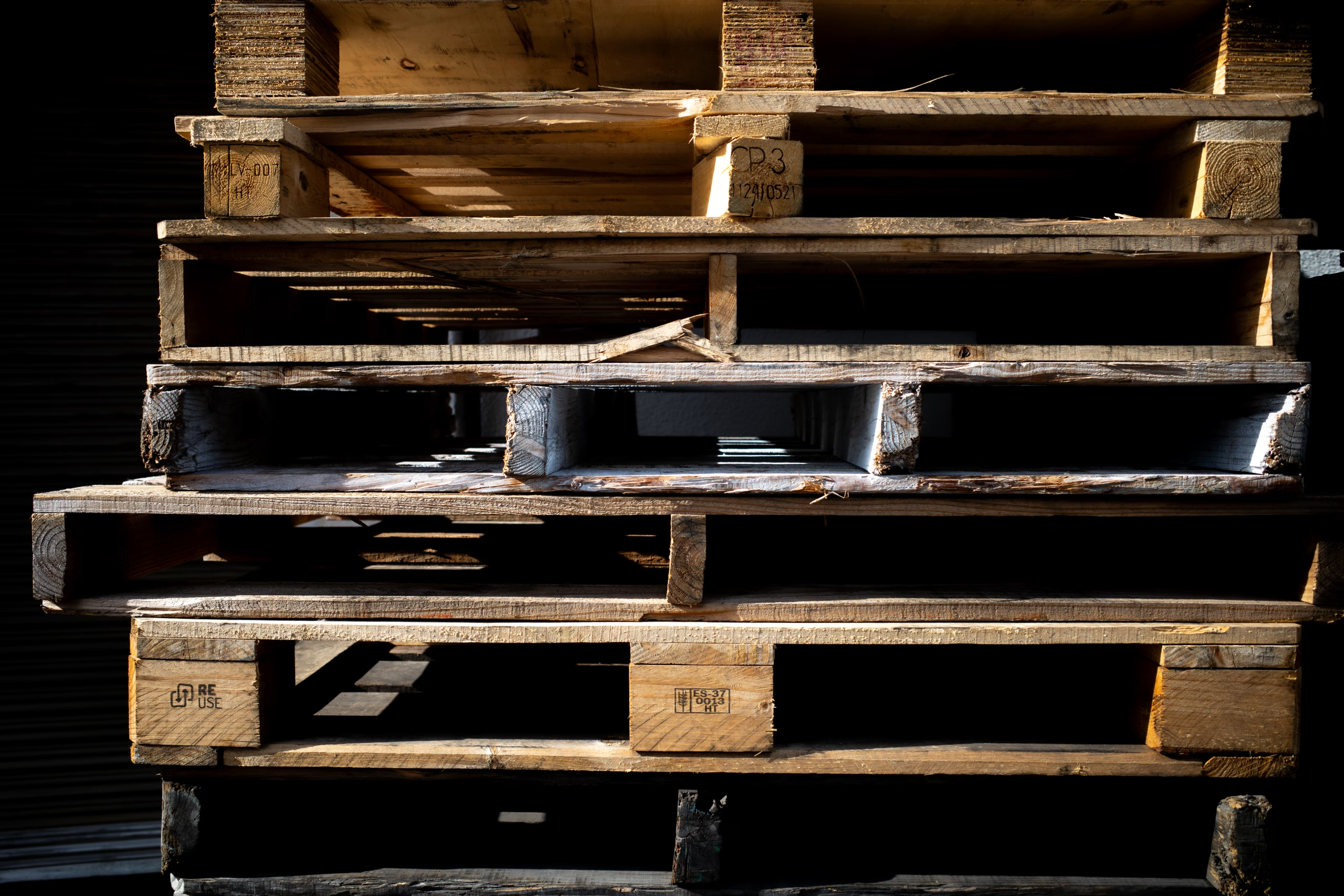
The Culture of Monozukuri
What does monozukuri mean? This research-based art project explores the culture of monozukuri (craftsmanship and manufacturing) in modern and contemporary Japan by focusing on the social history of machikoba (small local factories) in the Katsushika area of downtown Tokyo. Based on detailed research into the life histories of manufacturing workers and their families, our experimental programs illuminate the “human dimensions” embedded in the everyday labor of monozukuri through a variety of artistic practices.
Throughout the twentieth century, the manufacturing industry in the Katsushika area developed around small-scale factories. Since the last decade of the twentieth century, when the term monozukuri came to be widely used as a new expression referring to manufacturing craftsmanship, the production skills and techniques cultivated at the workshops of machikoba in downtown Tokyo have drawn renewed attention. Consequently, a series of policy measures and initiatives have been introduced to promote these skills and techniques and to ensure their transmission to future generations. Yet, while the expertise of monozukuri has come to be reappraised, the life and culture of factory workers who supported the growth of the manufacturing industry have not received sufficient attention.
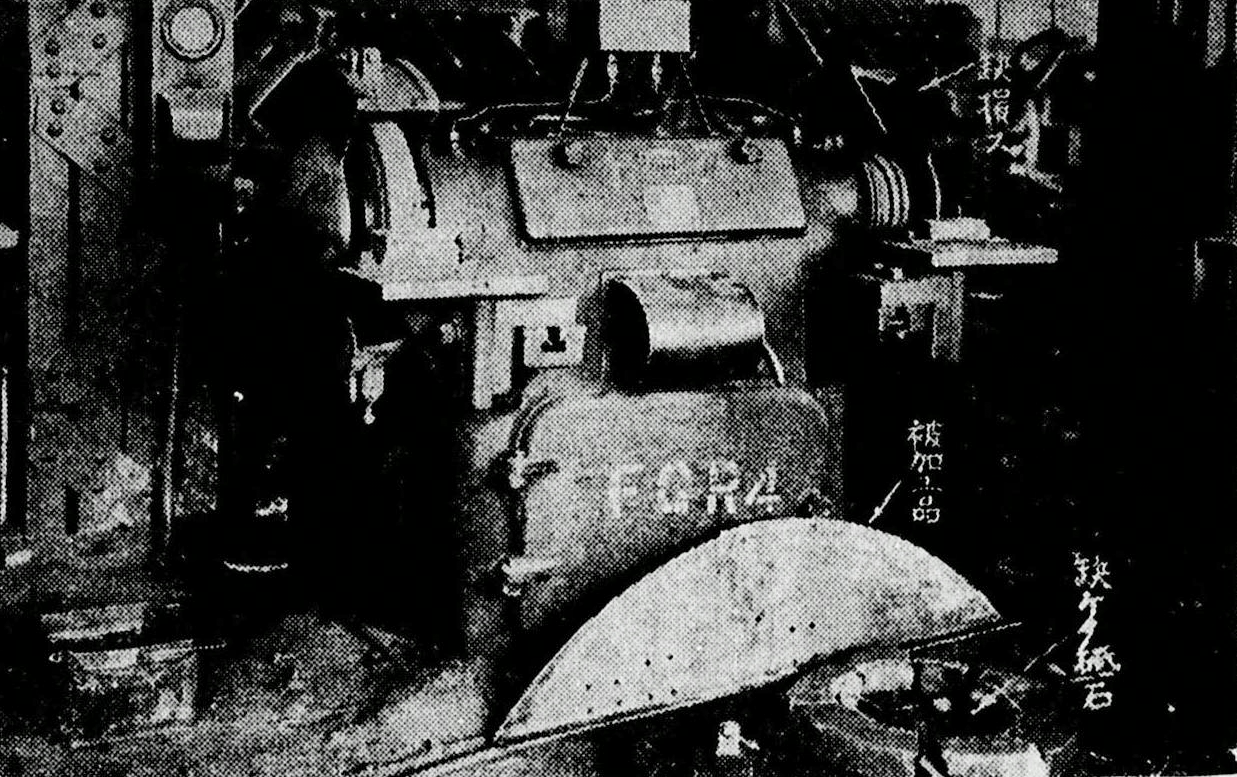
Source: 警視庁工場課編『工場安全教本』(東京工場協会, 1940年).
What has monozukuri meant in the everyday life and culture of downtown Tokyo? The project highlights not only the skills and techniques that developed in factories but also the people who sustained them through their strenuous labor. Drawing on the lived experiences of those who worked in and around manufacturing and related fields, our research initiative offers a perspective that situates monozukuri as part of the life histories of industrial workers and their families. Since the modern era, diverse groups of people have continuously flowed into the Katsushika area. While working at machikoba workshops, they have helped shape a rich variety of cultural practices in downtown Tokyo. By shifting focus from the things made to the people who made them, this project reframes our understanding of monozukuri within the cultural genealogy of downtown Tokyo.
The Japanese term monozukuri implies the primordial human act of “making (zukuri) things (mono),” a universal practice that has continued since the earliest stages of human history. Tracing the history of machikoba in the Katsushika area, this project illustrates the ways in which diverse forms of culture have emerged from the everyday practice of monozukuri.

“Site-Specificity” in Artistic Practice
While deciphering the living histories of downtown Tokyo, this project examines the question of “site-specificity” in artistic practice as a major issue of contemporary art theory.
In recent years, local art festivals in Japan have increasingly featured artworks that take the host area’s nature, history, and culture as their central themes. Yet what does it truly mean to be “site-specific” in artistic practice? By conducting research into everyday culture at various sites in downtown Tokyo, this project sheds critical light on the close entanglement between artistic expression and site-specificity.
The question of site-specificity extends beyond existing discussions of so-called site-specific art. Connected to the specificity of the site in which it is exhibited, every artwork acquires a unique meaning that can arise only in that place. Even the same artwork takes on different meanings and interpretations when it is exhibited in different locations. Certain conditions specific to each site, such as its natural environment, social circumstances, and historical background, influence the meanings and interpretations of the artwork. The site-responsivity thus characterizes the relationship between art and place. By focusing on the theoretical questions of “site,” this project pursues experimental inquiries into the aesthetic possibilities and ethical obligations of site-specific artistic practice.
Mideo M. Cruz (Term II)
Racquel de Loyola (Term II)
Gabriella Nataxa Garcia Gonzalez (Term I)
Mineki Murata (Term I/II)
Daisuke Takeya (Term I/II)
Takumichan (Term I/II)
Yeh Tzu-Chi (Term I)
Yeonjeong (Term II)
Mideo M. Cruz
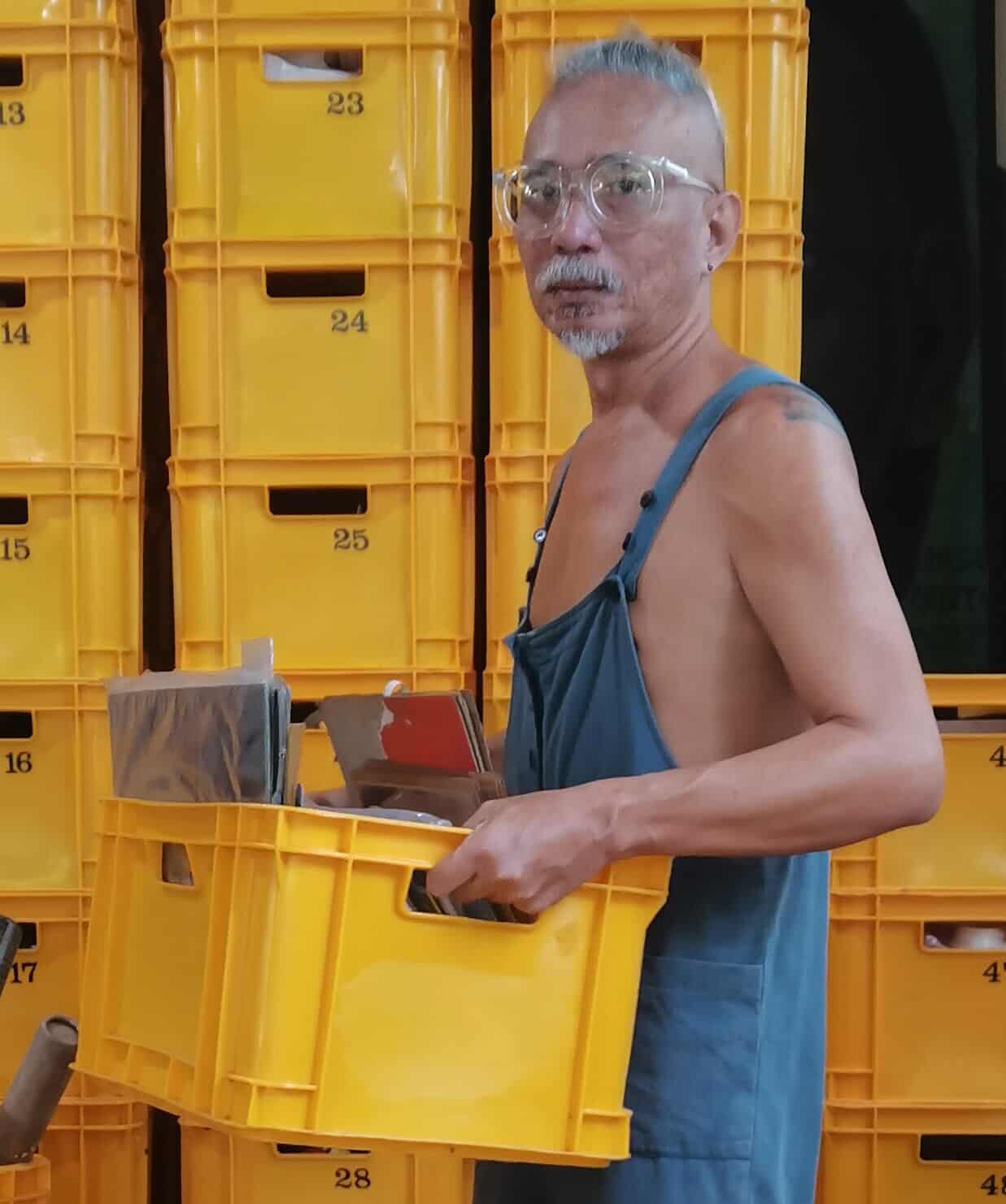
Mideo M. Cruz is a Filipino interdisciplinary artist whose practice operates at the intersection of research, performative action, and material appropriation. His work examines excess—as residue, surplus, spectacle, and ideological by-product—produced by capitalism, nationalism, religion, and pop culture. Rather than treating excess as waste, Cruz positions it as an archive: a site where power, desire, and contradiction become visible.
Rooted in performance but extending into installation, social engagement, and pedagogy, Cruz’s projects often reconfigure discarded symbols, overproduced imagery, and familiar cultural references. By appropriating what is already saturated—icons, narratives, commodities—he disrupts their assumed neutrality and exposes the systems that normalize them. Humor, discomfort, and spectacle function not as ends, but as tools for critical reflection. His research-based approach draws from lived experience, historical inquiry, and site-specific observation.
In Japan, Cruz’s ongoing research investigates how excess manifests within highly regulated systems—where restraint, repetition, and refinement coexist with hyper-consumption and symbolic overload. Performance becomes a method of inquiry: a way to test how bodies, rituals, and gestures absorb, resist, or reproduce excess in everyday life. Cruz is particularly interested in how performativity operates beyond the stage—how social roles, national myths, and moral codes are rehearsed and embodied. Influenced by expanded notions of art as a social force, his work resists mystification and challenges the separation between artistic production and daily existence. Alongside his artistic practice, Cruz is engaged in developing alternative educational frameworks that foreground creativity as a fundamental human capacity rather than a specialized talent. His work consistently argues that excess is not accidental, but structural—and that by confronting it directly, art can open spaces for critical imagination and collective rethinking.
Racquel de Loyola
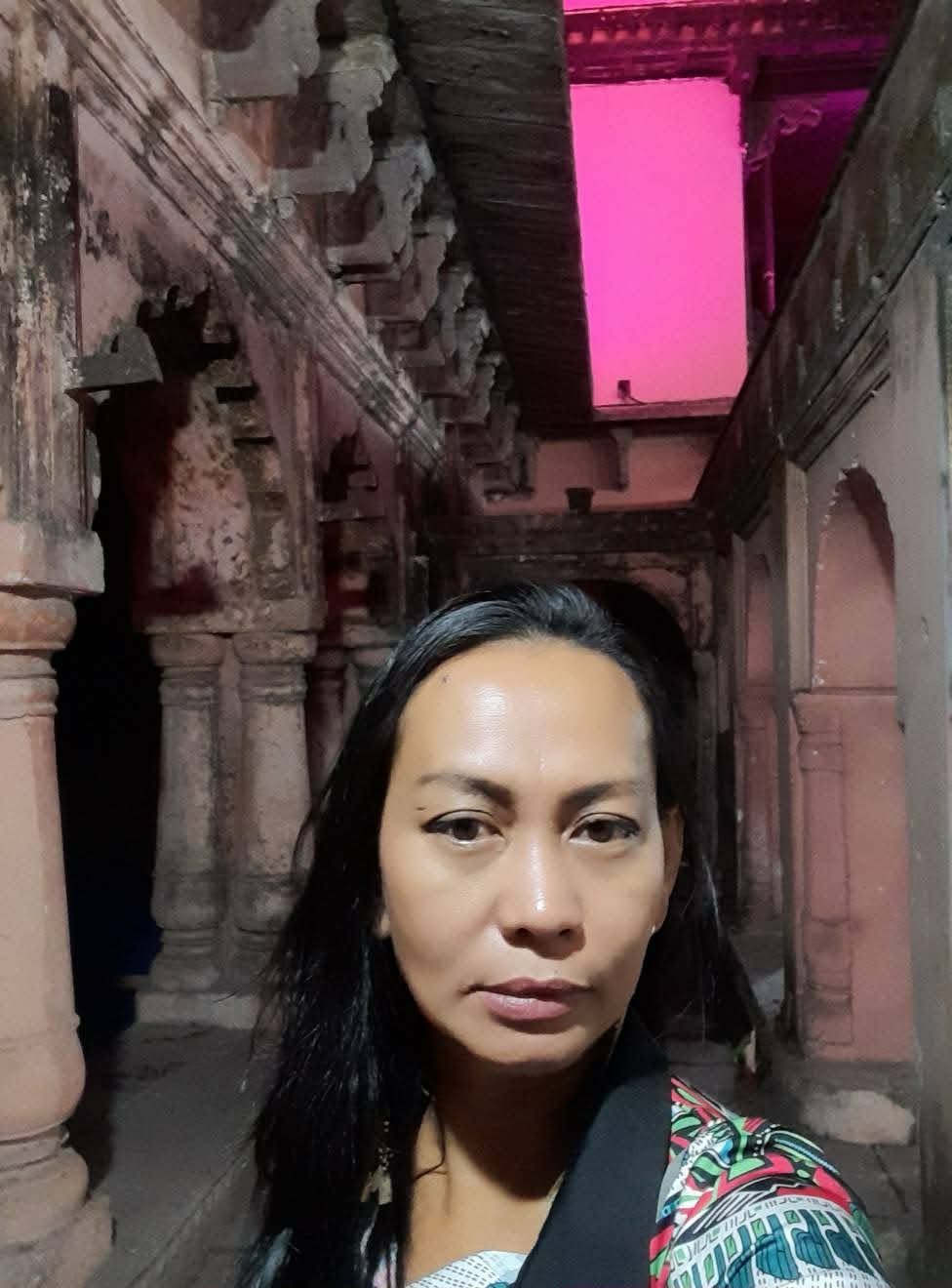
Racquel de Loyola is an artist based in the Philippines whose works primarily addresses women’s issue, identity, colonization, migration, displacement, capitalism, globalization and the present state of affairs.
A Darmasiswa scholar for Gamelan/Karawitan in 2002 at the Institut Seni Indonesia Yogyakarta Indonesia. One of the original lead vocalist for Manila based folk rock world music band named Talahib established by Noel Taylo in year 2000. She is one of the key initiator of an international open loose artist network called New World Disorder active during early and mid 2000, presented collaboration works locally and abroad in Manila and the Laokoon Festival in Kampnagel Hamburg Germany in 2004. Participated in the Asia Meets Asia Collaboration in Tokyo, Japan (2002 and 2005); the Currency Festival in New York, the United States (2004); and Asiatopia 05 in Bangkok, Thailand (2005). In 2006, she presented one of her works “Mebuyan Inexhaustible Sustenance” at 7a*11d International Performance Art Festival in Toronto, Ontario, Canada, and LIVE Biennale at Gallery Gachet in Vancouver, British Columbia, Canada. In 2007, she was shortlisted artist for the Ateneo Art Awards.
In 2008, she participated in Art Tuilage ’08 (Crane Lab, Chatteu de Chevigny in Burgundy and L’Olympic Café in Paris, France); Zoom!: Sudostasien Festival der Performance Art in International Performance Association Hildesheim (Hildesheim, Germany); and Performer Stammtisch Galleire Kunstlerische Furchung (gfkf) (Berlin, Germany). In 2009, she joined Open International Performance Art Festival Beijing China. In 2013, she presented performance at Grace Space Exhibition (Brooklyn, New York); Black Box Theater at John Jay College (New York); and Perform China Town (Los Angeles, California) in the United States. In 2017, she also presented her performance work at No Exit Live Performance Art Festival (Bangkok, Thailand).
De Loyola presented one of her major performative video installation work titled “Blemish” at the Main Gallery Cultural Center of the Philippines for the CCP 13 Artists Awards in 2009. She presented one of her works “Mound” for Absence Performance Art Residency/Exhibition at the Manila Contemporary in 2011. She is one of the participating artists for the Triumph of Philippine Art Exhibition at George Segal Gallery in Montclair University (Montclair, New Jersey) and at the Fisher Museum (Los Angeles, California) in the United States in 2013; and at the Ayala Museum (Makati City) in the Philippines in 2014. She was a recipient of Asian Cultural Council fellowship program artist residency in New York City in year 2012.
She actively engaged and presented works locally and abroad. Living off grid the City, she and her husband have currently established and developed their artist initiative place called BANGAN Project Space located in Central Luzon Philippines. De Loyola continues explorations with crossing established disciplines and other possibilities. She is currently working with soft fabric sculptures and clothe-based expositions.
Creative practice starts on accumulated ideas which motivate individuals to turn these thoughts into creative actions, movement, or any means of expressions. Her works focus on unbundling the boundaries of art. She believes that unconventional cross-disciplinary exploration brings back an integrated creative form which is more familiar with everybody thus bridging the gap between art and real life. Sans fantasies but keeping the magical empirical mysteries of survival as well as creative creation and self-expression. Guided by these concerns, her works primarily address the issues on women, gender, colonization, commodity, consumerism, migration, displacement, identity, globalization and our present state of affairs in this face of uncertainty.
Gabriella Nataxa Garcia Gonzalez
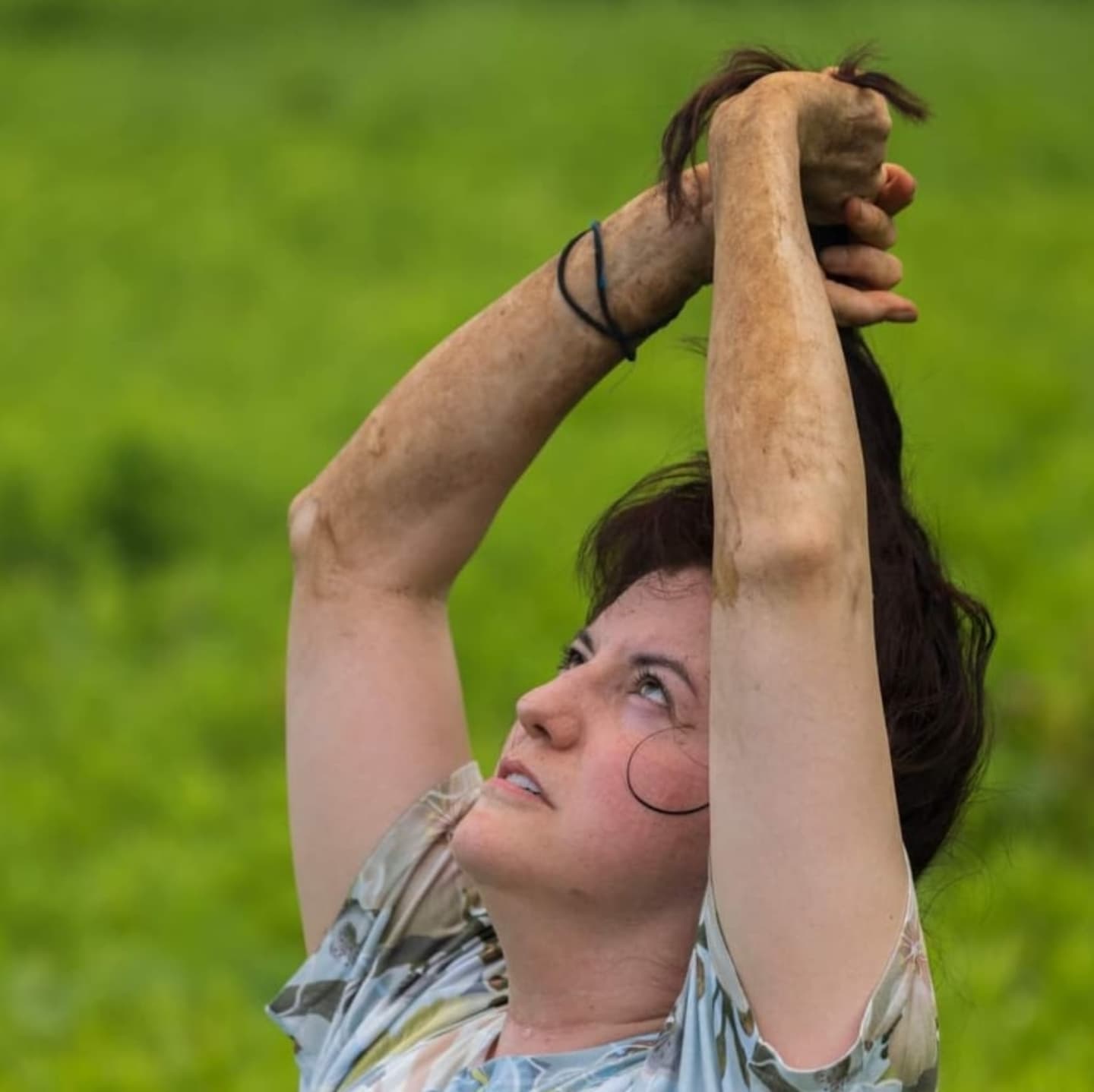
Gabriella Nataxa García González was born in México City. Living in Tokyo, Japan, since January 2024, she has focused on expanded printmaking and performance art in her artistic practice. Graduated from the Guanajuato University (Fine Arts), México, Nataxa has worked as a video artist and animator, and showed her work in numerous short film festivals. She is currently a member of CAF.N (Contemporary Art Festival Nebula), an artist group in Saitama, Japan. In 2024, she joined the “R6: Releasing and Healing” in Fukushima and Ishinomaki. In 2025, she participated in exhibitions in Germany, Tokyo, Chiba, and Aguascalientes, exploring the intersection of graphic drawing and body.
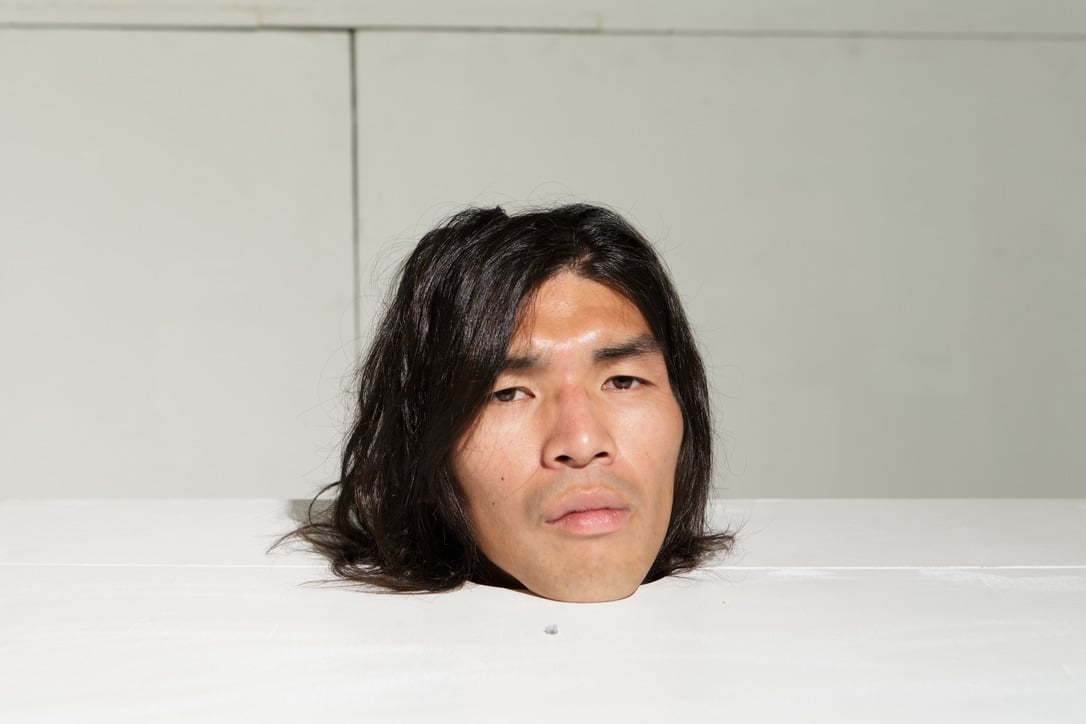
Mineki Murata
Mineki Murata was born in Gunma Prefecture and currently lives in Maebashi City. He graduated from the Department of Sculpture, Faculty of Fine Arts, Tama Art University in 2005. Murata creates his drawings and performances based on his understanding that the primordial act of kaku consists of four fundamental elements: kaku as writing in consciousness, drawing as consequence, scratching as action, and lacking as potentiality. He understands performance as thinking and responding through the body, sharpening his bodily senses and persistently struggling within the constrained objects and situations before him in order to unravel them. He is currently participating in the following artist collectives: Ongoing Collective, Responding Performance Art Initiative, and Shintai no Hitotachi.
His solo exhibitions include BAR (void+, 2026); Tortoise (Art Center Ongoing Tokyo, 2025); a mirror of yourself (shop rin art association, 2025); Position (Second 2, 2024); Out-Of-Body (rin art association, 2024); Transition (Maebashi Galleria Gallery 2, 2023); share (Tama Art University Sculpture Building Gallery, 2023); effect (rin artassociation, 2021); Borderman (Art Center Ongoing, 2019). Group exhibitions include idea note ( Studio Morooka, 2025); It is indeed strange how things can be become so fascinating (Wandervogel Gallery, 2025); ul (Hotel Lulud, 2025); Close to the Body, Close to the Voice (gallery 10 [TOH] Tokyo 2025); New Acquisition Exhibition (Museum of Modern Art, 2024); Touching (Hsinchu City Museum, Taiwan, 2024); Collectors Turning the World (Fukuoka Art Museum, 2024); Void+Stock: Koji Tanada, Jun Honma, Midori Mitamura, Mineki Murata (void+, 2024); New Horizon Vision of the Future (Arts Maebashi, 2023); Platform || Pause – rest+restore (BankART KAIKO, 2023); Uninhabited Island: War and the Body (zit dim art space, 2023); and N/World (Mtk Contemporary Art, 2022).He participated in numerous performance events, which include Te, Ashi, Kuchi (Saga University, 2025); since then l from now (theater Kinematica, et. al., 2023); 2019 LIVE International Performance Art Biennale in Vancouver (gland floor, 2019); Genjin: Takuzou Kubikukuri, Fuyuki Yamakawa, Mineki Murata (Maebashi City Arts and Culture Rengaura, 2016).
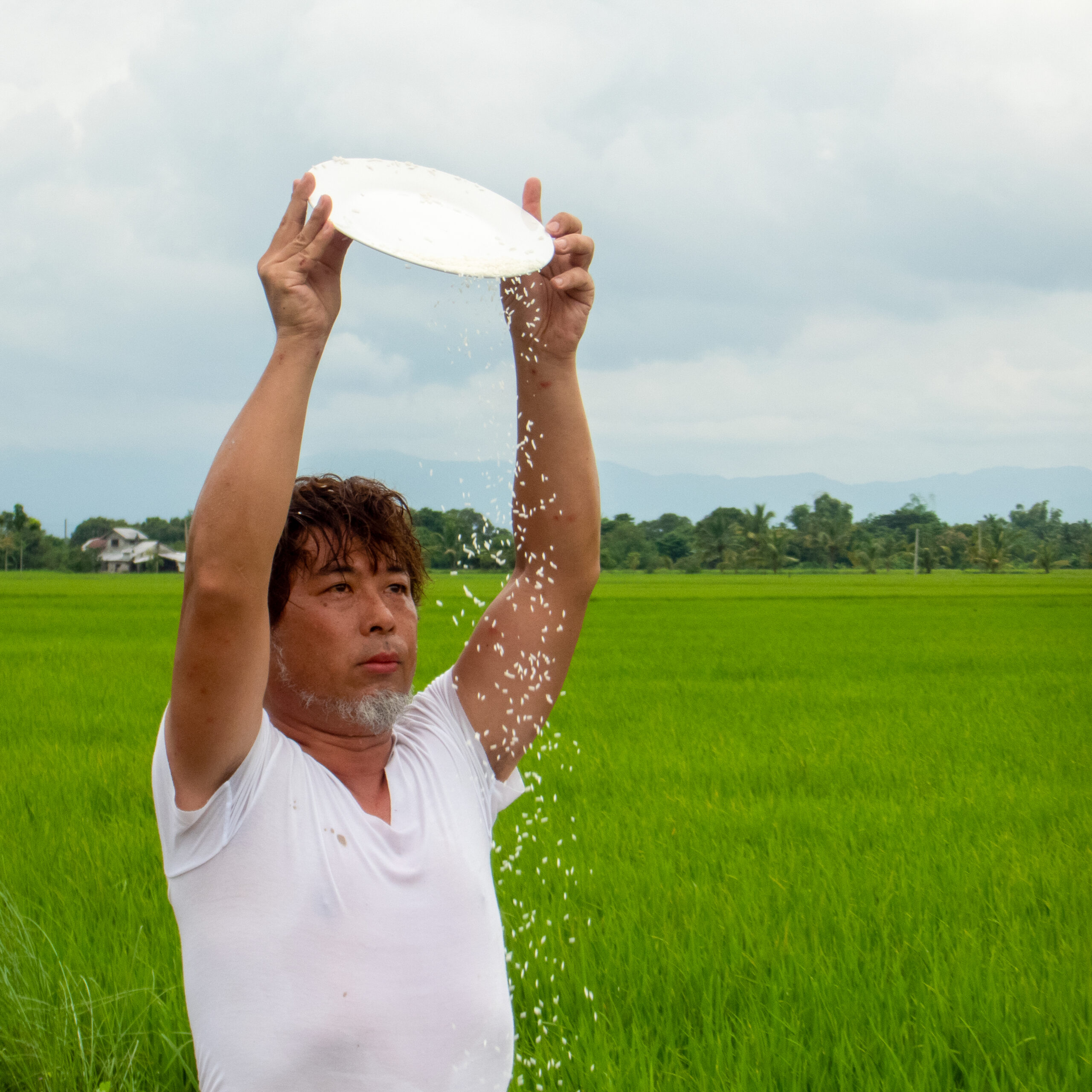
Daisuke Takeya
Born and raised in Japan, interdisciplinary artist Daisuke Takeya obtained a Master of Fine Arts degree from the Graduate School of Figurative Art at the New York Academy of Art and received Bachelor of Fine Arts degree from the School of Visual Arts in New York City. His praxis is comprised of the exploration of nature and plausibility in contemporary society, and hinges on all kinds of double meanings. Currently based in Toronto, Canada, and Ishinomaki, Japan, Daisuke has participated in numerous solo and group exhibitions internationally. Venues have included the Museum of Contemporary Art Toronto, Nuit Blanche (Toronto), SVA Gallery (NYC), Wagner College Gallery (NYC), Kyoto Art Center, Saison Art Program, Roppongi Art Night 2013, Fukushima Contemporary Art Biennale, Canon New Cosmos Exhibition, Yamagata Biennale, the Japan Foundation, Toronto, and the Prince Takamado Gallery at the Embassy of Canada in Japan. Daisuke is also the representative and curator of Field Trip Project/Field Trip Project Asia, Responding Performance Art Initiative, and one of the founders of Transnational Coalition for the Arts (Transnation), and DAIS Ishinomaki.
www.daisuketakeya.com
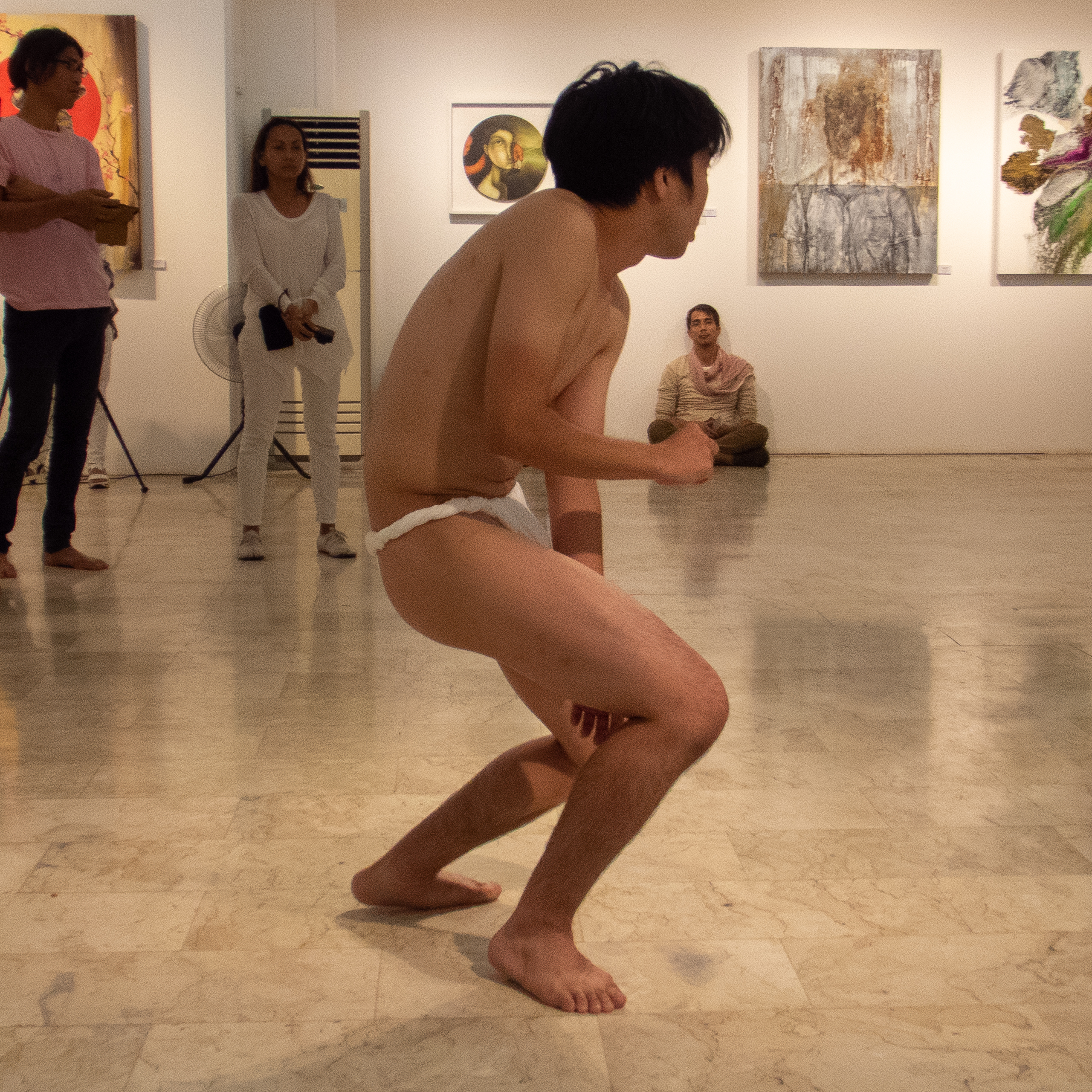
Takumichan
Takumichan is an artist based in Tokyo. He generates performances by focusing on differences in how a single object appears to different people as the source of his practice. In doing so, he constructs his own theory of improvisation. His work is cross-disciplinary, including contemporary dance, performance art, and theater. In recent years, he has participated in performance art projects in Xi’an, China (GUYU ACTION, 2025) and in Ishinomaki, Miyagi (R6:Releasing and Healing, 2024). His representative works include “-(dash)#2 Rosetta Stone” presented at Tokyo Arts and Space.
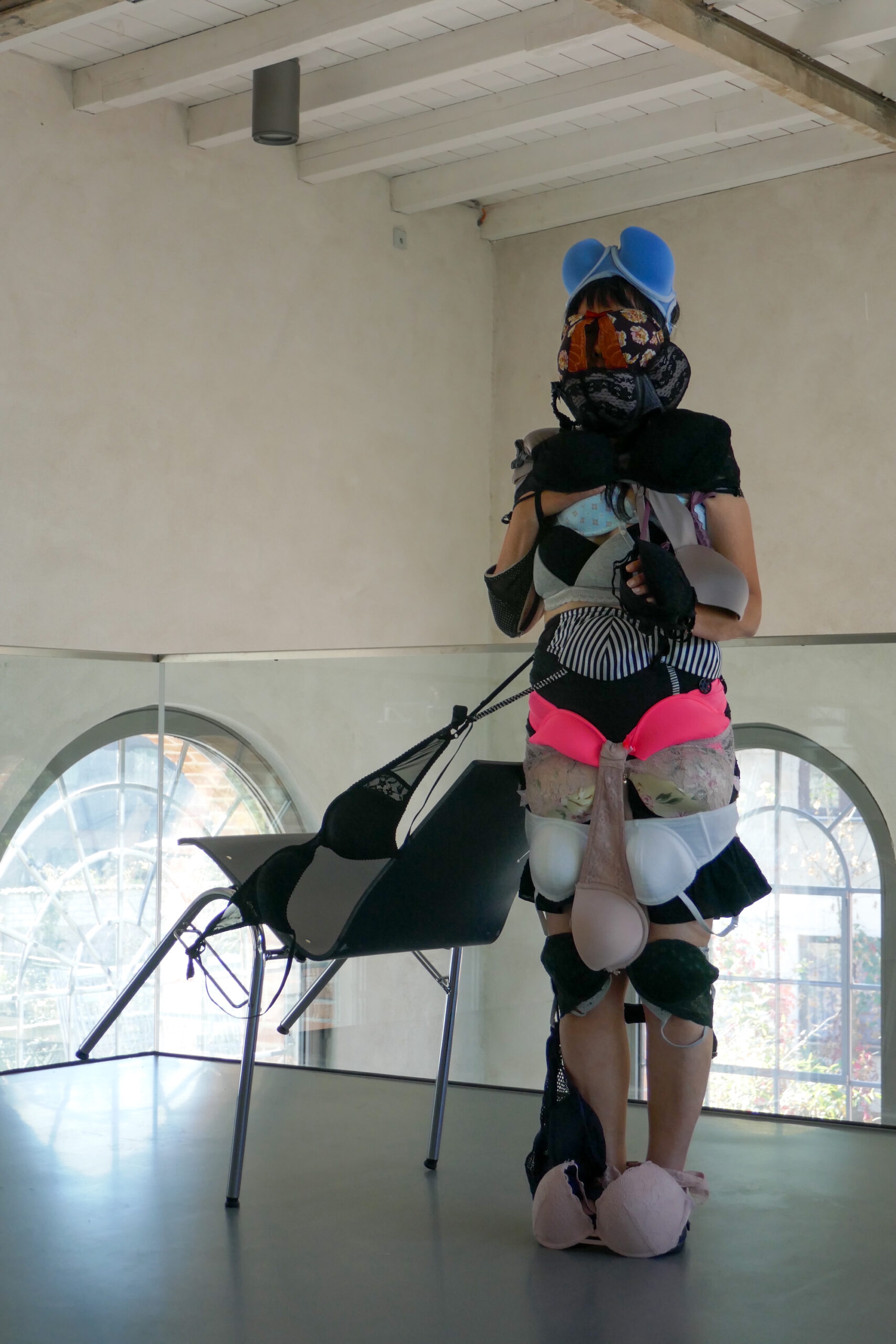
Yeh Tzu-Chi
Yeh Tzu-Chi (葉子啓) is a performance artist and organizer based in Taiwan. With a background of English and Western Literature, she had been an editor of a literary monthly magazine, a full-time English lecturer at a junior college, and a freelance translator/writer before she turned to performance art in 2002. She has been invited to Japan, South Korea, the Philippines, China, Myanmar, Thailand, France, Indonesia, Singapore, Macau, Poland, Slovakia, Hungary, Finland, Israel, Croatia, Canada, Mexico, the United States, Germany, Switzerland, Chile, Argentina, and Hong Kong to show her live performance or the document videos/photos.
Her works are quite diverse in form and subject. Female experience, gender issues, animal rights, nature/environment, politics, history, and refugee, etc. are what she concerns more. Very often, she uses her body (and sometimes with audience), together with minimalist ready-made materials to perform and in the process of action, she brings out the concept she wants to convey. In recent years, she is more and more sensitive to the environment where she performs. Two of her early performance (“Hair Tie” and “Human Egg vs Animal Egg”) have been collected by the Macau Museum of Art. And she is a participating artist of “Sub Zoology: 2020 Taiwan Biennale.” In 2003, she founded “ArTrend Performance Group,” under which she has organized 5 large-scale international performance art festivals, quite a few local performance events and workshops across Taiwan, and published 6 document catalogues.
https://yehtzuchiart.wordpress.com/
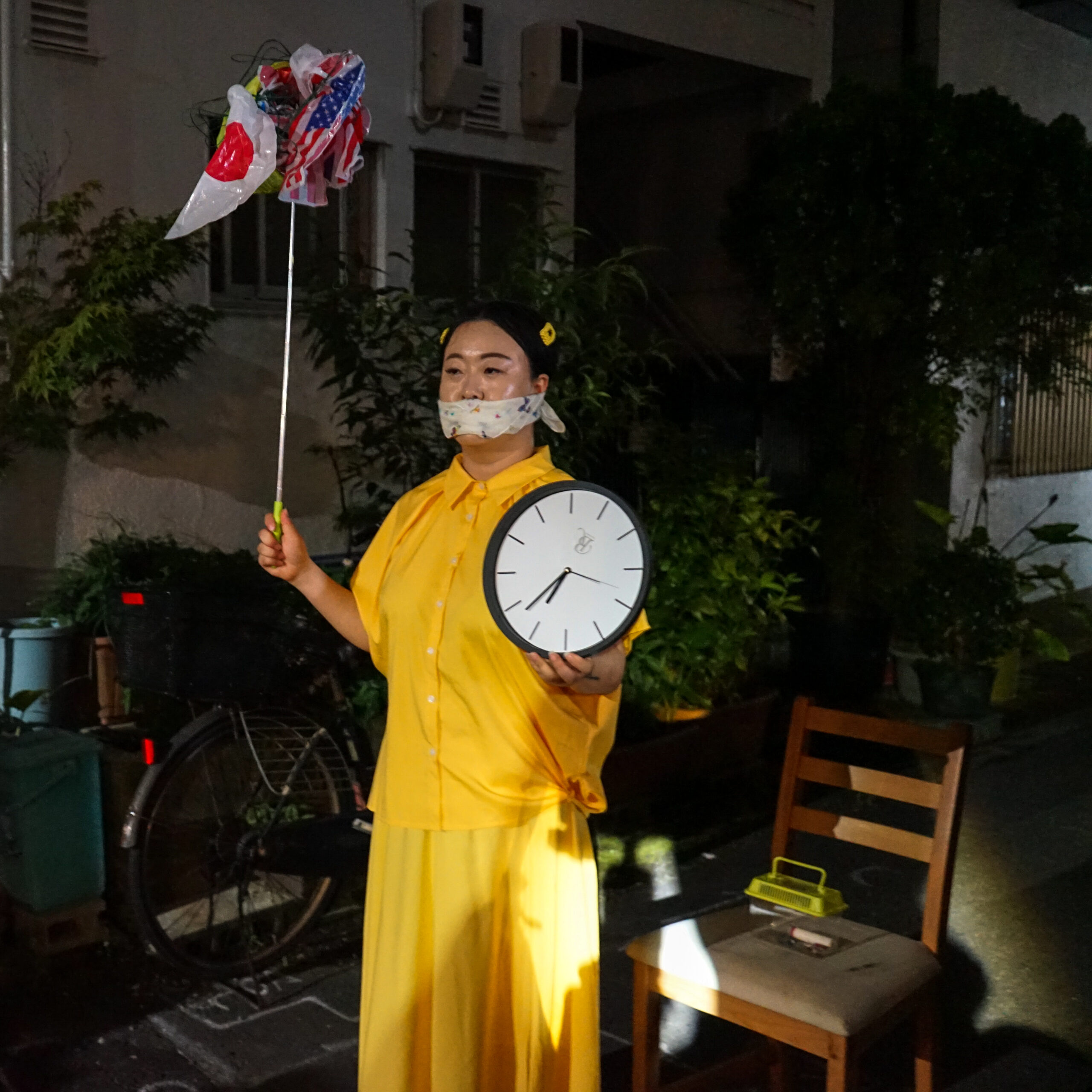
Yeonjeong
Yeonjeong is an interdisciplinary artist and organizer of Feminale. She deals with various mediums in an experimental manner, with a particular focus on performance and video. She aims to make artistic interventions in ordinary life, as well as bring out social and cultural issues in her performances both critically and humorously. As an organizer, she has been doing several projects: Feminale (Asia + Performance art + Free Female), Media Body (Media experimentation + Performance art ), etc.
Yeonjeong completed an MFA in film from University of Wisconsin Milwaukee, the United States. She worked as a visiting professor and lecturer at Korean National University of Arts, Sungkyunkwan University, Seoul Institute of the Arts, Kaywon University of Art & Design, Howon University, etc. Residencies include: China, Taiwan, Thailand (Bangkok, Chiangmai, Nan), Myanmar, Indonesia, Germany, Vietnam, Philippines and many places in Korea. She has exhibited at: Macau Biennale 2025 (Macau); Singapore Biennale 2022 (Singapore); 11th Up-On International Performance Festival (China); Blurborder International Performance Art Exchange (Thailand); Echt Jetzt International Performance Festival (Germany); The Above Clouds International Live Art Festival (China); VivaExcon Biennale (Philippines); New Zero Platform International Performance Festival (Myanmar); Responding International Performance Art Festival and Meeting (Japan); Solidarity International Performance Art Festival (Philippines); Rotterdam International Film Festival (Netherlands); San Paulo International Short Film Festival (Brazil); Ankara International Film Festival (Turkey); L’Étrange International Film Festival (France); Asolo International Film and Video Festival (Italy); Jihilava International Film and Video Festival (Czech); and Belgrade International Documentary and Video Festival (Serbia), etc.
https://linktr.ee/YeonJeong.K
https://www.instagram.com/yeonjeong_artist/
https://www.instagram.com/feminale.asia
https://www.facebook.com/femicology/
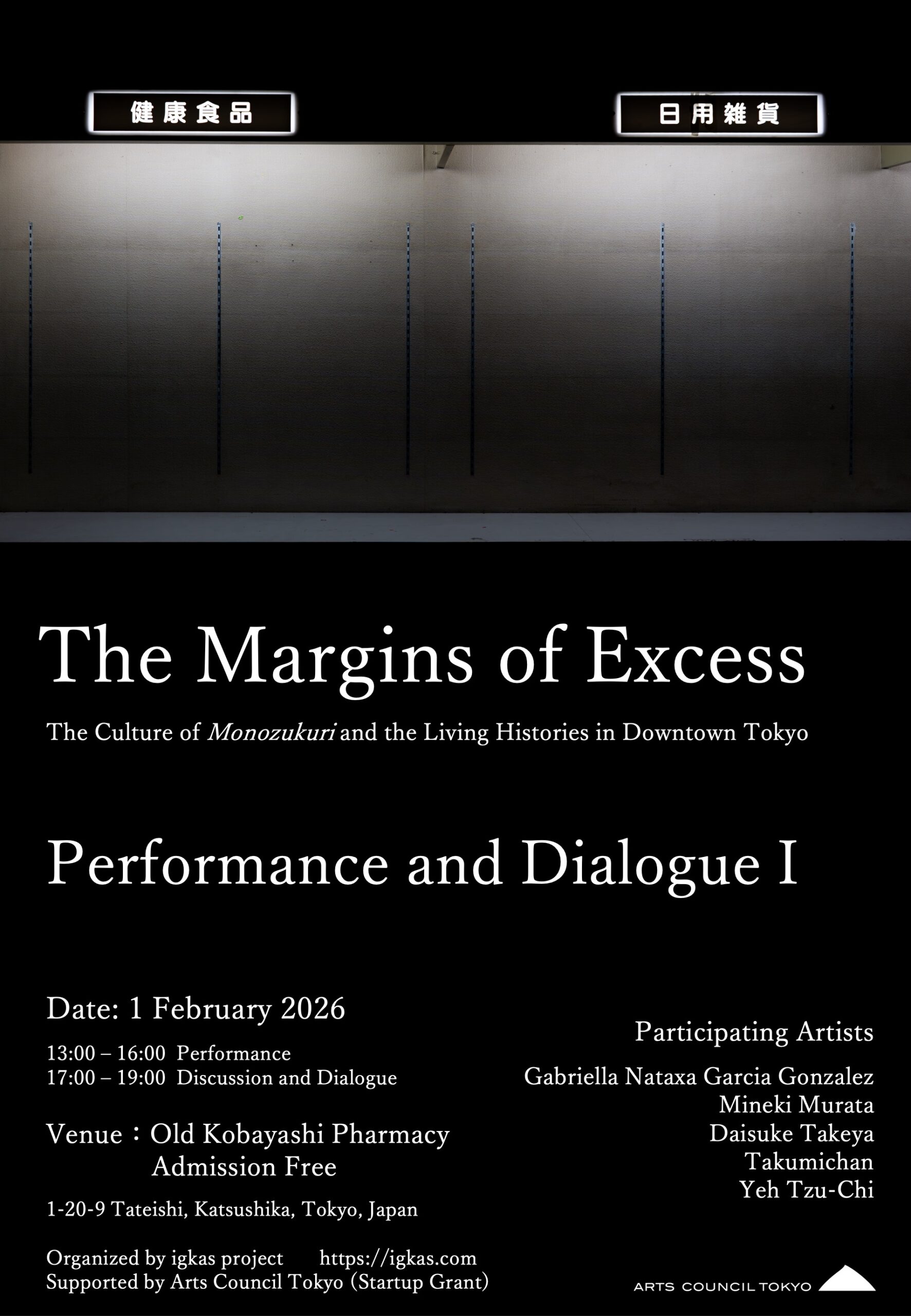
| 27 January-1 February 2026 | |
| 27 January (Tue) | |
| 9:00-17:00 | Field Research in Tateishi, Ohanachaya, and Kosuge Area |
| 18:00-19:30 | Discussion and Dialogue I at Old Kobayashi Pharmacy |
| 28 January (Wed) | |
| 9:00-16:00 | Field Research in the Arakawa Riverside Area and Yotsugi |
| 18:00-19:30 | Discussion and Dialogue II at Old Kobayashi Pharmacy |
| 29 January (Thu) | |
| All Day | Individual Research |
| 18:00-19:30 | Discussion and Dialogue III at Old Kobayashi Pharmacy |
| 30 January (Fri) | |
| All Day | Individual Research |
| 18:00-19:30 | Discussion and Dialogue IV at Old Kobayashi Pharmacy |
| 31 January (Sat) | |
| 12:00-17:00 | On-Site Performative Praxis |
| 18:00-19:30 | Discussion and Dialogue V at Old Kobayashi Pharmacy |
| 1 February (Sun) | |
| 13:00-16:00 | Final Performance Gathering at Old Kobayashi Pharmacy |
| 17:00-19:00 | Discussion and Dialogue VI at Old Kobayashi Pharmacy |
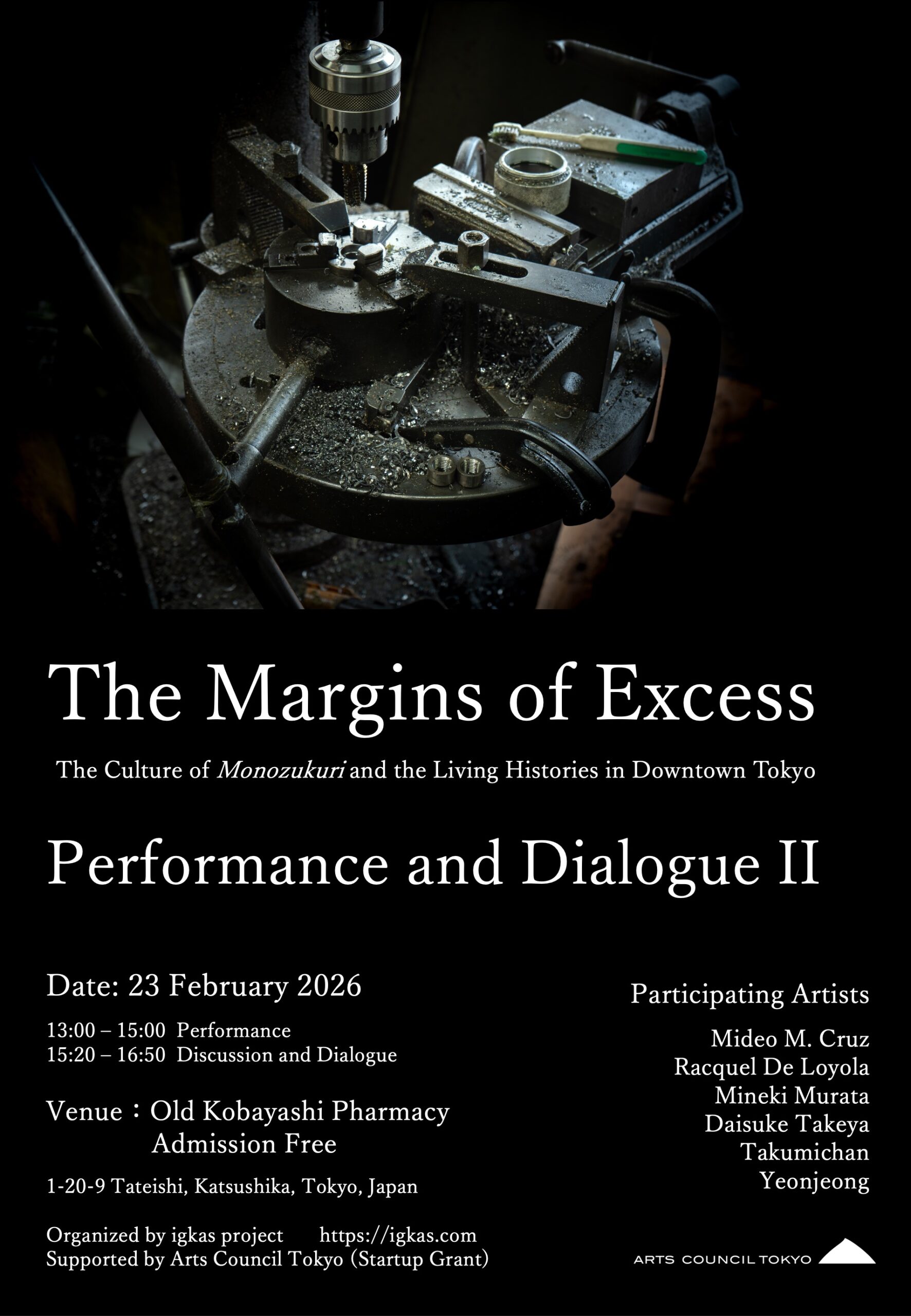
| 17-23 February 2026 | |
| 17 February (Tue) | |
| 17:00-18:00 | Pre-Screening |
| 18 February (Wed) | |
| 10:00-15:30 | Field Research in Shibamata, Kanamachi, and Kameari |
| 16:00-17:30 | Introductory Guidance at Old Kobayashi Pharmacy |
| 19 February (Thu) | |
| 9:00-17:30 | Field Research in the Areas West of the Arakawa Floodway |
| 20 February (Fri) | |
| All Day | Individual Research |
| 18:00-19:30 | Discussion and Dialogue at Old Kobayashi Pharmacy |
| 21 February (Sat) | |
| All Day | Individual Research |
| 22 February (Sun) | |
| 12:00-17:00 | On-Site Performative Praxis |
| 17:00-19:00 | Discussion and Dialogue VI at Old Kobayashi Pharmacy |
| 23 February (Mon) | |
| 13:00-15:00 | Final Performance Gathering at Old Kobayashi Pharmacy |
| 15:20-16:50 | Discussion and Dialogue at Old Kobayashi Pharmacy |
| Exhibition Schedule at Old Kobayashi Pharmacy | |
| 18 (Wed) | 16:00-19:00 |
| 19 (Thu) | 15:00-18:00 |
| 20 (Fri) | 16:00-19:00 |
| 21 (Sat) | 16:00-19:00 |
| 22 (Sun) | 16:00-19:00 |
| 23 (Mon) | 13:00-17:00 |
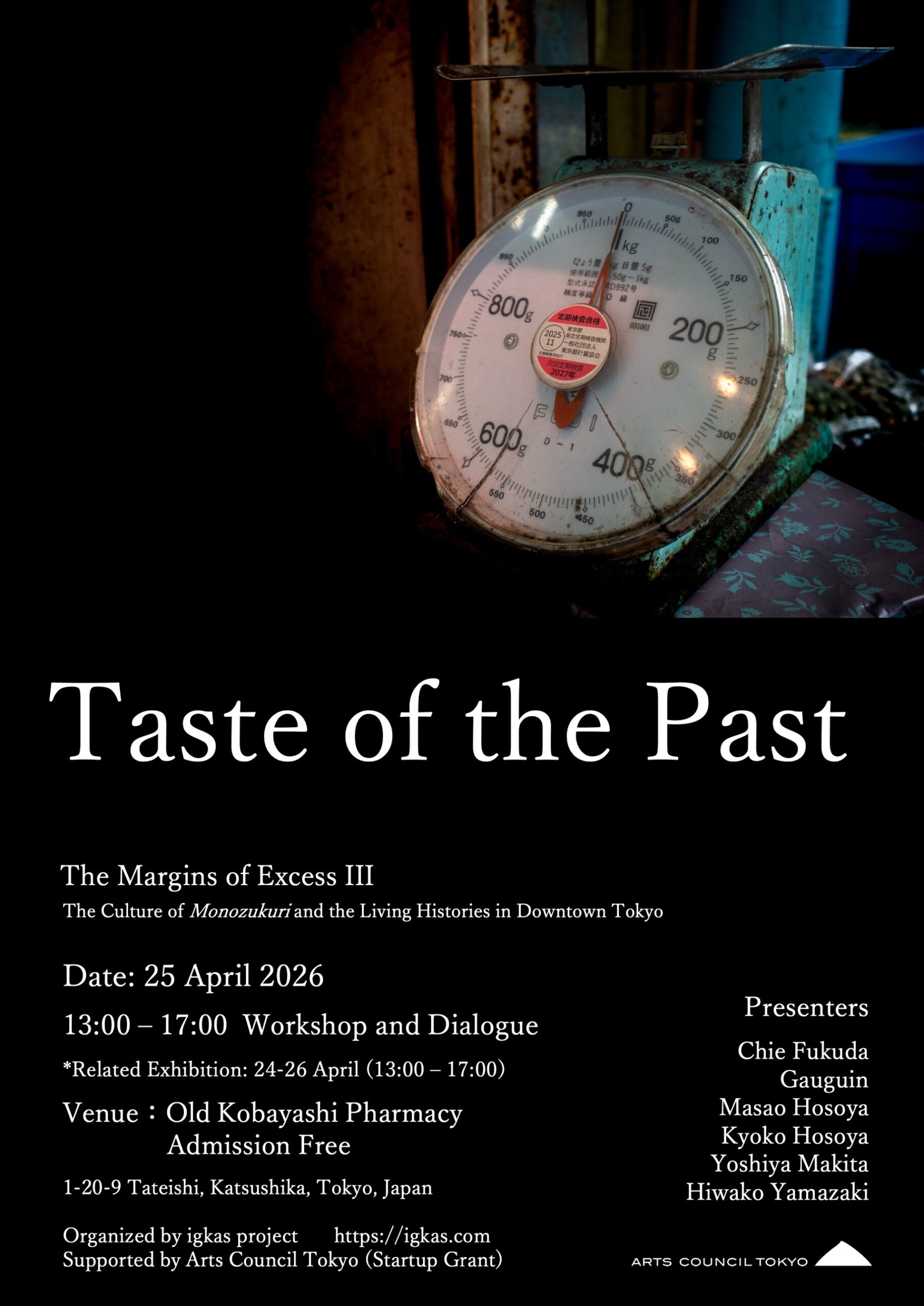
| 24 -26 April 2026 | |
| 24-26 April (Fri-Sun) 13:00-17:00 Exhibition at Old Kobayashi Pharmacy | |
| 25 April (Sat) 13:00-17:00 Exhibition at Old Kobayashi Pharmacy |
Main Venue: Old Kobayashi Pharmacy
1-20-9 Tateishi, Katsushika, Tokyo
Term I 27 January-1 February 2026 (Research and Performance)
Term II 17-23 February 2026 (Research, Exhibit, and Performance)
Term III 24-26 April 2026 (Exhibit and Workshop)
Organized by igkas project
Supported by Arts Council Tokyo (Startup Grant)
Source: 東京市葛飾区編『葛飾区史』(東京市葛飾区, 1936年).
The sum of the necessary labor and the surplus labor, or the sum of the periods of time in which the worker replaces the value of his labor-power and produces the surplus value, constitutes the absolute magnitude of his labor-time, i.e., the working day.
(Karl Marx, Das Kapital: Kritik der politischen Ökonomie, Bd. I, Dritter Abschnitt, in Karl Marx-Friedrich Engels Werke, ed. Institut für Marxismus-Leninismus beim Zentralkomitee der SED (Berlin, DDR: Dietz Verlag, 1974 [1867]), S. 244.)
I usually worked overtime from five-thirty in the evening until eight, and then headed to the club office. When I arrived there, a crowd of young people had already gathered, printing materials for things like travel groups, haiku gatherings, and reading circles. I joined them—helping with the printing and taking part in meetings—and before I knew it, it was already midnight. I hurried to catch the red train home, went to bed around one-thirty, and the next morning I was shaken awake again at five-thirty.
(Masao Sugiura, ed., Senjichu Insatsu Rodosha no Tatakai no Kiroku (Tokyo: Shuppanko Kurabu, 1964), 72-73.)
Synopsis
In twentieth-century Japan, the development of the manufacturing industry in downtown Tokyo accelerated the nation’s economic growth and helped fuel the pursuit of material abundance among the general populace in consumer society. As desires for economic prosperity swelled in society at large, however, factory workers in the downtown area nurtured alternative cultures of their own—cultures that cannot be measured by the yardstick of material wealth. This project highlights the unique cultures of industrial workers and their families, who struggled through their everyday realities on the fringes of commodity-saturated society.
More production, more profits. Throughout modern and contemporary history, factory labor has been driven by an economic principle of excess, an unwavering pursuit of “more.” Yet the economic language of mass production and profit maximization alone cannot fully explain the lived realities of factory workers. By focusing on the everyday cultures that sprang up in the “margins” of factory labor, this project illuminates alternative visions of work, life, and culture from historical perspectives.
The Culture of Monozukuri
What does monozukuri mean? This research-based art project explores the culture of monozukuri (craftsmanship and manufacturing) in modern and contemporary Japan by focusing on the social history of machikoba (small local factories) in the Katsushika area of downtown Tokyo. Based on detailed research into the life histories of manufacturing workers and their families, our experimental programs illuminate the “human dimensions” embedded in the everyday labor of monozukuri through a variety of artistic practices.
Throughout the twentieth century, the manufacturing industry in the Katsushika area developed around small-scale factories. Since the last decade of the twentieth century, when the term monozukuri came to be widely used as a new expression referring to manufacturing craftsmanship, the production skills and techniques cultivated at the workshops of machikoba in downtown Tokyo have drawn renewed attention. Consequently, a series of policy measures and initiatives have been introduced to promote these skills and techniques and to ensure their transmission to future generations. Yet, while the expertise of monozukuri has come to be reappraised, the life and culture of factory workers who supported the growth of the manufacturing industry have not received sufficient attention.
Source: 警視庁工場課編『工場安全教本』(東京工場協会, 1940年).
What has monozukuri meant in the everyday life and culture of downtown Tokyo? The project highlights not only the skills and techniques that developed in factories but also the people who sustained them through their strenuous labor. Drawing on the lived experiences of those who worked in and around manufacturing and related fields, our research initiative offers a perspective that situates monozukuri as part of the life histories of industrial workers and their families. Since the modern era, diverse groups of people have continuously flowed into the Katsushika area. While working at machikoba workshops, they have helped shape a rich variety of cultural practices in downtown Tokyo. By shifting focus from the things made to the people who made them, this project reframes our understanding of monozukuri within the cultural genealogy of downtown Tokyo.
The Japanese term monozukuri implies the primordial human act of “making (zukuri) things (mono),” a universal practice that has continued since the earliest stages of human history. Tracing the history of machikoba in the Katsushika area, this project illustrates the ways in which diverse forms of culture have emerged from the everyday practice of monozukuri.
“Site-Specificity” in Artistic Practice
While deciphering the living histories of downtown Tokyo, this project examines the question of “site-specificity” in artistic practice as a major issue of contemporary art theory.
In recent years, local art festivals in Japan have increasingly featured artworks that take the host area’s nature, history, and culture as their central themes. Yet what does it truly mean to be “site-specific” in artistic practice? By conducting research into everyday culture at various sites in downtown Tokyo, this project sheds critical light on the close entanglement between artistic expression and site-specificity.
The question of site-specificity extends beyond existing discussions of so-called site-specific art. Connected to the specificity of the site in which it is exhibited, every artwork acquires a unique meaning that can arise only in that place. Even the same artwork takes on different meanings and interpretations when it is exhibited in different locations. Certain conditions specific to each site, such as its natural environment, social circumstances, and historical background, influence the meanings and interpretations of the artwork. The site-responsivity thus characterizes the relationship between art and place. By focusing on the theoretical questions of “site,” this project pursues experimental inquiries into the aesthetic possibilities and ethical obligations of site-specific artistic practice.
Mideo M. Cruz (Term II)
Racquel de Loyola (Term II)
Gabriella Nataxa Garcia Gonzalez (Term I)
Mineki Murata (Term I/II)
Daisuke Takeya (Term I/II)
Takumichan (Term I/II)
Yeh Tzu-Chi (Term I)
Yeonjeong (Term II)
Mideo M. Cruz
Mideo M. Cruz is a Filipino interdisciplinary artist whose practice operates at the intersection of research, performative action, and material appropriation. His work examines excess—as residue, surplus, spectacle, and ideological by-product—produced by capitalism, nationalism, religion, and pop culture. Rather than treating excess as waste, Cruz positions it as an archive: a site where power, desire, and contradiction become visible.
Rooted in performance but extending into installation, social engagement, and pedagogy, Cruz’s projects often reconfigure discarded symbols, overproduced imagery, and familiar cultural references. By appropriating what is already saturated—icons, narratives, commodities—he disrupts their assumed neutrality and exposes the systems that normalize them. Humor, discomfort, and spectacle function not as ends, but as tools for critical reflection. His research-based approach draws from lived experience, historical inquiry, and site-specific observation.
In Japan, Cruz’s ongoing research investigates how excess manifests within highly regulated systems—where restraint, repetition, and refinement coexist with hyper-consumption and symbolic overload. Performance becomes a method of inquiry: a way to test how bodies, rituals, and gestures absorb, resist, or reproduce excess in everyday life. Cruz is particularly interested in how performativity operates beyond the stage—how social roles, national myths, and moral codes are rehearsed and embodied. Influenced by expanded notions of art as a social force, his work resists mystification and challenges the separation between artistic production and daily existence. Alongside his artistic practice, Cruz is engaged in developing alternative educational frameworks that foreground creativity as a fundamental human capacity rather than a specialized talent. His work consistently argues that excess is not accidental, but structural—and that by confronting it directly, art can open spaces for critical imagination and collective rethinking.
Racquel de Loyola
Racquel de Loyola is an artist based in the Philippines whose works primarily addresses women’s issue, identity, colonization, migration, displacement, capitalism, globalization and the present state of affairs.
A Darmasiswa scholar for Gamelan/Karawitan in 2002 at the Institut Seni Indonesia Yogyakarta Indonesia. One of the original lead vocalist for Manila based folk rock world music band named Talahib established by Noel Taylo in year 2000. She is one of the key initiator of an international open loose artist network called New World Disorder active during early and mid 2000, presented collaboration works locally and abroad in Manila and the Laokoon Festival in Kampnagel Hamburg Germany in 2004. Participated in the Asia Meets Asia Collaboration in Tokyo, Japan (2002 and 2005); the Currency Festival in New York, the United States (2004); and Asiatopia 05 in Bangkok, Thailand (2005). In 2006, she presented one of her works “Mebuyan Inexhaustible Sustenance” at 7a*11d International Performance Art Festival in Toronto, Ontario, Canada, and LIVE Biennale at Gallery Gachet in Vancouver, British Columbia, Canada. In 2007, she was shortlisted artist for the Ateneo Art Awards.
In 2008, she participated in Art Tuilage ’08 (Crane Lab, Chatteu de Chevigny in Burgundy and L’Olympic Café in Paris, France); Zoom!: Sudostasien Festival der Performance Art in International Performance Association Hildesheim (Hildesheim, Germany); and Performer Stammtisch Galleire Kunstlerische Furchung (gfkf) (Berlin, Germany). In 2009, she joined Open International Performance Art Festival Beijing China. In 2013, she presented performance at Grace Space Exhibition (Brooklyn, New York); Black Box Theater at John Jay College (New York); and Perform China Town (Los Angeles, California) in the United States. In 2017, she also presented her performance work at No Exit Live Performance Art Festival (Bangkok, Thailand).
De Loyola presented one of her major performative video installation work titled “Blemish” at the Main Gallery Cultural Center of the Philippines for the CCP 13 Artists Awards in 2009. She presented one of her works “Mound” for Absence Performance Art Residency/Exhibition at the Manila Contemporary in 2011. She is one of the participating artists for the Triumph of Philippine Art Exhibition at George Segal Gallery in Montclair University (Montclair, New Jersey) and at the Fisher Museum (Los Angeles, California) in the United States in 2013; and at the Ayala Museum (Makati City) in the Philippines in 2014. She was a recipient of Asian Cultural Council fellowship program artist residency in New York City in year 2012.
She actively engaged and presented works locally and abroad. Living off grid the City, she and her husband have currently established and developed their artist initiative place called BANGAN Project Space located in Central Luzon Philippines. De Loyola continues explorations with crossing established disciplines and other possibilities. She is currently working with soft fabric sculptures and clothe-based expositions.
Creative practice starts on accumulated ideas which motivate individuals to turn these thoughts into creative actions, movement, or any means of expressions. Her works focus on unbundling the boundaries of art. She believes that unconventional cross-disciplinary exploration brings back an integrated creative form which is more familiar with everybody thus bridging the gap between art and real life. Sans fantasies but keeping the magical empirical mysteries of survival as well as creative creation and self-expression. Guided by these concerns, her works primarily address the issues on women, gender, colonization, commodity, consumerism, migration, displacement, identity, globalization and our present state of affairs in this face of uncertainty.
Gabriella Nataxa Garcia Gonzalez
Gabriella Nataxa García González was born in México City. Living in Tokyo, Japan, since January 2024, she has focused on expanded printmaking and performance art in her artistic practice. Graduated from the Guanajuato University (Fine Arts), México, Nataxa has worked as a video artist and animator, and showed her work in numerous short film festivals. She is currently a member of CAF.N (Contemporary Art Festival Nebula), an artist group in Saitama, Japan. In 2024, she joined the “R6: Releasing and Healing” in Fukushima and Ishinomaki. In 2025, she participated in exhibitions in Germany, Tokyo, Chiba, and Aguascalientes, exploring the intersection of graphic drawing and body.
Mineki Murata
Mineki Murata was born in Gunma Prefecture and currently lives in Maebashi City. He graduated from the Department of Sculpture, Faculty of Fine Arts, Tama Art University in 2005. Murata creates his drawings and performances based on his understanding that the primordial act of kaku consists of four fundamental elements: kaku as writing in consciousness, drawing as consequence, scratching as action, and lacking as potentiality. He understands performance as thinking and responding through the body, sharpening his bodily senses and persistently struggling within the constrained objects and situations before him in order to unravel them. He is currently participating in the following artist collectives: Ongoing Collective, Responding Performance Art Initiative, and Shintai no Hitotachi.
His solo exhibitions include BAR (void+, 2026); Tortoise (Art Center Ongoing Tokyo, 2025); a mirror of yourself (shop rin art association, 2025); Position (Second 2, 2024); Out-Of-Body (rin art association, 2024); Transition (Maebashi Galleria Gallery 2, 2023); share (Tama Art University Sculpture Building Gallery, 2023); effect (rin artassociation, 2021); Borderman (Art Center Ongoing, 2019). Group exhibitions include idea note ( Studio Morooka, 2025); It is indeed strange how things can be become so fascinating (Wandervogel Gallery, 2025); ul (Hotel Lulud, 2025); Close to the Body, Close to the Voice (gallery 10 [TOH] Tokyo 2025); New Acquisition Exhibition (Museum of Modern Art, 2024); Touching (Hsinchu City Museum, Taiwan, 2024); Collectors Turning the World (Fukuoka Art Museum, 2024); Void+Stock: Koji Tanada, Jun Honma, Midori Mitamura, Mineki Murata (void+, 2024); New Horizon Vision of the Future (Arts Maebashi, 2023); Platform || Pause – rest+restore (BankART KAIKO, 2023); Uninhabited Island: War and the Body (zit dim art space, 2023); and N/World (Mtk Contemporary Art, 2022).He participated in numerous performance events, which include Te, Ashi, Kuchi (Saga University, 2025); since then l from now (theater Kinematica, et. al., 2023); 2019 LIVE International Performance Art Biennale in Vancouver (gland floor, 2019); Genjin: Takuzou Kubikukuri, Fuyuki Yamakawa, Mineki Murata (Maebashi City Arts and Culture Rengaura, 2016).
Daisuke Takeya
Born and raised in Japan, interdisciplinary artist Daisuke Takeya obtained a Master of Fine Arts degree from the Graduate School of Figurative Art at the New York Academy of Art and received Bachelor of Fine Arts degree from the School of Visual Arts in New York City. His praxis is comprised of the exploration of nature and plausibility in contemporary society, and hinges on all kinds of double meanings. Currently based in Toronto, Canada, and Ishinomaki, Japan, Daisuke has participated in numerous solo and group exhibitions internationally. Venues have included the Museum of Contemporary Art Toronto, Nuit Blanche (Toronto), SVA Gallery (NYC), Wagner College Gallery (NYC), Kyoto Art Center, Saison Art Program, Roppongi Art Night 2013, Fukushima Contemporary Art Biennale, Canon New Cosmos Exhibition, Yamagata Biennale, the Japan Foundation, Toronto, and the Prince Takamado Gallery at the Embassy of Canada in Japan. Daisuke is also the representative and curator of Field Trip Project/Field Trip Project Asia, Responding Performance Art Initiative, and one of the founders of Transnational Coalition for the Arts (Transnation), and DAIS Ishinomaki.
www.daisuketakeya.com
Takumichan
Takumichan is an artist based in Tokyo. He generates performances by focusing on differences in how a single object appears to different people as the source of his practice. In doing so, he constructs his own theory of improvisation. His work is cross-disciplinary, including contemporary dance, performance art, and theater. In recent years, he has participated in performance art projects in Xi’an, China (GUYU ACTION, 2025) and in Ishinomaki, Miyagi (R6:Releasing and Healing, 2024). His representative works include “-(dash)#2 Rosetta Stone” presented at Tokyo Arts and Space.
Yeh Tzu-Chi
Yeh Tzu-Chi (葉子啓) is a performance artist and organizer based in Taiwan. With a background of English and Western Literature, she had been an editor of a literary monthly magazine, a full-time English lecturer at a junior college, and a freelance translator/writer before she turned to performance art in 2002. She has been invited to Japan, South Korea, the Philippines, China, Myanmar, Thailand, France, Indonesia, Singapore, Macau, Poland, Slovakia, Hungary, Finland, Israel, Croatia, Canada, Mexico, the United States, Germany, Switzerland, Chile, Argentina, and Hong Kong to show her live performance or the document videos/photos.
Her works are quite diverse in form and subject. Female experience, gender issues, animal rights, nature/environment, politics, history, and refugee, etc. are what she concerns more. Very often, she uses her body (and sometimes with audience), together with minimalist ready-made materials to perform and in the process of action, she brings out the concept she wants to convey. In recent years, she is more and more sensitive to the environment where she performs. Two of her early performance (“Hair Tie” and “Human Egg vs Animal Egg”) have been collected by the Macau Museum of Art. And she is a participating artist of “Sub Zoology: 2020 Taiwan Biennale.” In 2003, she founded “ArTrend Performance Group,” under which she has organized 5 large-scale international performance art festivals, quite a few local performance events and workshops across Taiwan, and published 6 document catalogues.
https://yehtzuchiart.wordpress.com/
Yeonjeong
Yeonjeong is an interdisciplinary artist and organizer of Feminale. She deals with various mediums in an experimental manner, with a particular focus on performance and video. She aims to make artistic interventions in ordinary life, as well as bring out social and cultural issues in her performances both critically and humorously. As an organizer, she has been doing several projects: Feminale (Asia + Performance art + Free Female), Media Body (Media experimentation + Performance art ), etc.
Yeonjeong completed an MFA in film from University of Wisconsin Milwaukee, the United States. She worked as a visiting professor and lecturer at Korean National University of Arts, Sungkyunkwan University, Seoul Institute of the Arts, Kaywon University of Art & Design, Howon University, etc. Residencies include: China, Taiwan, Thailand (Bangkok, Chiangmai, Nan), Myanmar, Indonesia, Germany, Vietnam, Philippines and many places in Korea. She has exhibited at: Macau Biennale 2025 (Macau); Singapore Biennale 2022 (Singapore); 11th Up-On International Performance Festival (China); Blurborder International Performance Art Exchange (Thailand); Echt Jetzt International Performance Festival (Germany); The Above Clouds International Live Art Festival (China); VivaExcon Biennale (Philippines); New Zero Platform International Performance Festival (Myanmar); Responding International Performance Art Festival and Meeting (Japan); Solidarity International Performance Art Festival (Philippines); Rotterdam International Film Festival (Netherlands); San Paulo International Short Film Festival (Brazil); Ankara International Film Festival (Turkey); L’Étrange International Film Festival (France); Asolo International Film and Video Festival (Italy); Jihilava International Film and Video Festival (Czech); and Belgrade International Documentary and Video Festival (Serbia), etc.
https://linktr.ee/YeonJeong.K
https://www.instagram.com/yeonjeong_artist/
https://www.instagram.com/feminale.asia
https://www.facebook.com/femicology/
| 27 January-1 February 2026 | |
| 27 January (Tue) | |
| 9:00-17:00 | Field Research in Tateishi, Ohanachaya, and Kosuge Area |
| 18:00-19:30 | Discussion and Dialogue I at Old Kobayashi Pharmacy |
| 28 January (Wed) | |
| 9:00-16:00 | Field Research in the Arakawa Riverside Area and Yotsugi |
| 18:00-19:30 | Discussion and Dialogue II at Old Kobayashi Pharmacy |
| 29 January (Thu) | |
| All Day | Individual Research |
| 18:00-19:30 | Discussion and Dialogue III at Old Kobayashi Pharmacy |
| 30 January (Fri) | |
| All Day | Individual Research |
| 18:00-19:30 | Discussion and Dialogue IV at Old Kobayashi Pharmacy |
| 31 January (Sat) | |
| 12:00-17:00 | On-Site Performative Praxis |
| 18:00-19:30 | Discussion and Dialogue V at Old Kobayashi Pharmacy |
| 1 February (Sun) | |
| 13:00-16:00 | Final Performance Gathering at Old Kobayashi Pharmacy |
| 17:00-19:00 | Discussion and Dialogue VI at Old Kobayashi Pharmacy |
| 17-23 February 2026 | |
| 17 February (Tue) | |
| 17:00-18:00 | Pre-Screening |
| 18 February (Wed) | |
| 10:00-15:30 | Field Research in Shibamata, Kanamachi, and Kameari |
| 16:00-17:30 | Introductory Guidance at Old Kobayashi Pharmacy |
| 19 February (Thu) | |
| 9:00-17:30 | Field Research in the Areas West of the Arakawa Floodway |
| 20 February (Fri) | |
| All Day | Individual Research |
| 18:00-19:30 | Discussion and Dialogue at Old Kobayashi Pharmacy |
| 21 February (Sat) | |
| All Day | Individual Research |
| 22 February (Sun) | |
| 12:00-17:00 | On-Site Performative Praxis |
| 17:00-19:00 | Discussion and Dialogue VI at Old Kobayashi Pharmacy |
| 23 February (Mon) | |
| 13:00-15:00 | Final Performance Gathering at Old Kobayashi Pharmacy |
| 15:20-16:50 | Discussion and Dialogue at Old Kobayashi Pharmacy |
| Exhibition Schedule at Old Kobayashi Pharmacy | |
| 18 (Wed) | 16:00-19:00 |
| 19 (Thu) | 15:00-18:00 |
| 20 (Fri) | 16:00-19:00 |
| 21 (Sat) | 16:00-19:00 |
| 22 (Sun) | 16:00-19:00 |
| 23 (Mon) | 13:00-17:00 |
| 24 -26 April 2026 | |
| 24-26 April (Fri-Sun) 13:00-17:00 Exhibition at Old Kobayashi Pharmacy | |
| 25 April (Sat) 13:00-17:00 Exhibition at Old Kobayashi Pharmacy |
Main Venue: Old Kobayashi Pharmacy
1-20-9 Tateishi, Katsushika, Tokyo
Term I 27 January-1 February 2026
Term II 17-23 February 2026
Term III 24-26 April 2026
Organized by igkas project
Supported by Arts Council Tokyo (Startup Grant)
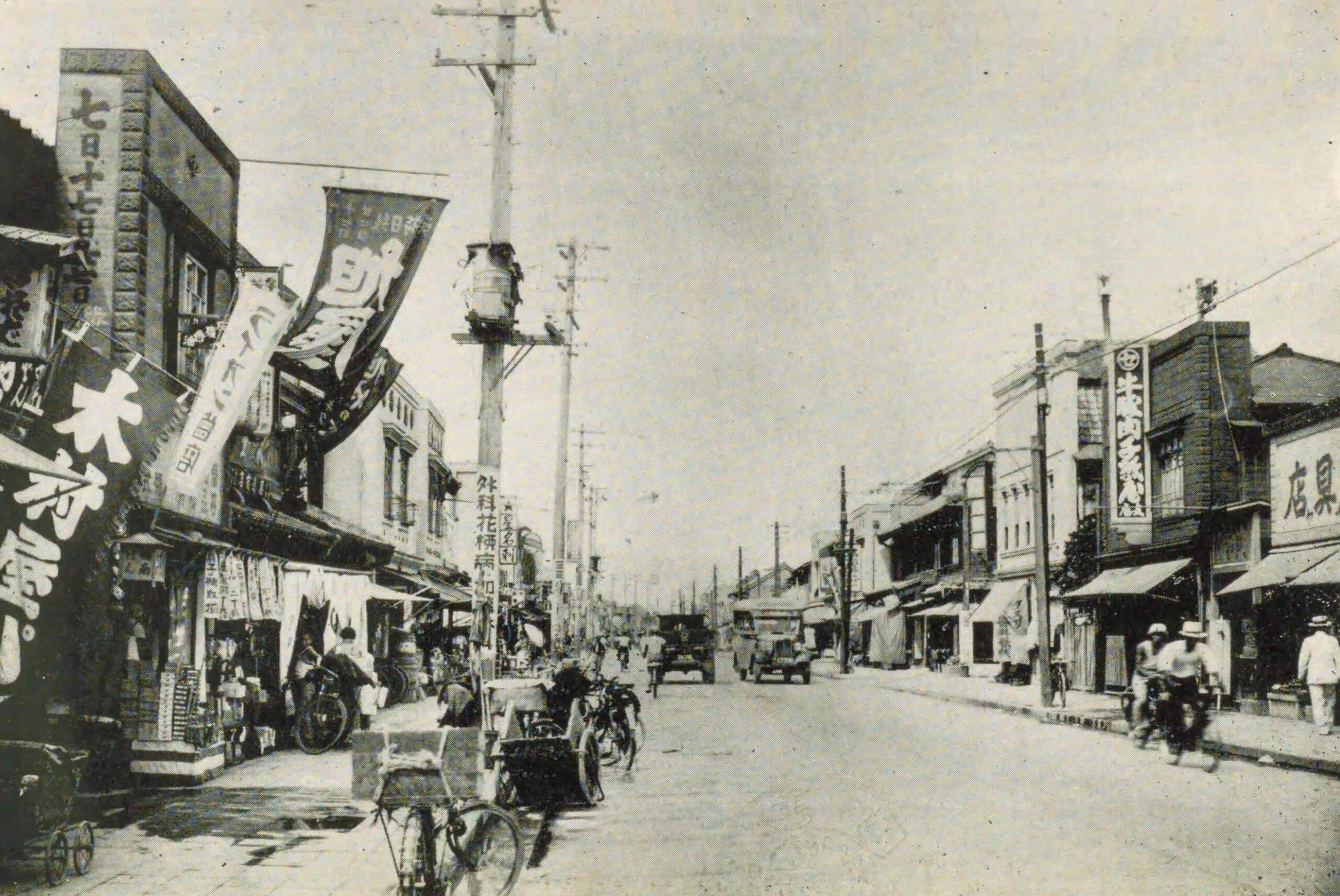
Source: 東京市葛飾区編『葛飾区史』(東京市葛飾区, 1936年)
The sum of the necessary labor and the surplus labor, or the sum of the periods of time in which the worker replaces the value of his labor-power and produces the surplus value, constitutes the absolute magnitude of his labor-time, i.e., the working day.
(Karl Marx, Das Kapital: Kritik der politischen Ökonomie, Bd. I, Dritter Abschnitt, in Karl Marx-Friedrich Engels Werke, ed. Institut für Marxismus-Leninismus beim Zentralkomitee der SED (Berlin, DDR: Dietz Verlag, 1974 [1867]), S. 244.)
I usually worked overtime from five-thirty in the evening until eight, and then headed to the club office. When I arrived there, a crowd of young people had already gathered, printing materials for things like travel groups, haiku gatherings, and reading circles. I joined them—helping with the printing and taking part in meetings—and before I knew it, it was already midnight. I hurried to catch the red train home, went to bed around one-thirty, and the next morning I was shaken awake again at five-thirty.
(Masao Sugiura, ed., Senjichu Insatsu Rodosha no Tatakai no Kiroku (Tokyo: Shuppanko Kurabu, 1964), 72-73.)
Synopsis
In twentieth-century Japan, the development of the manufacturing industry in downtown Tokyo accelerated the nation’s economic growth and helped fuel the pursuit of material abundance among the general populace in consumer society. As desires for economic prosperity swelled in society at large, however, factory workers in the downtown area nurtured alternative cultures of their own—cultures that cannot be measured by the yardstick of material wealth. This project highlights the unique cultures of industrial workers and their families, who struggled through their everyday realities on the fringes of commodity-saturated society.
More production, more profits. Throughout modern and contemporary history, factory labor has been driven by an economic principle of excess, an unwavering pursuit of “more.” Yet the economic language of mass production and profit maximization alone cannot fully explain the lived realities of factory workers. By focusing on the everyday cultures that sprang up in the “margins” of factory labor, this project illuminates alternative visions of work, life, and culture from historical perspectives.
The Culture of Monozukuri
What does monozukuri mean? This research-based art project explores the culture of monozukuri (craftsmanship and manufacturing) in modern and contemporary Japan by focusing on the social history of machikoba (small local factories) in the Katsushika area of downtown Tokyo. Based on detailed research into the life histories of manufacturing workers and their families, our experimental programs illuminate the “human dimensions” embedded in the everyday labor of monozukuri through a variety of artistic practices.
Throughout the twentieth century, the manufacturing industry in the Katsushika area developed around small-scale factories. Since the last decade of the twentieth century, when the term monozukuri came to be widely used as a new expression referring to manufacturing craftsmanship, the production skills and techniques cultivated at the workshops of machikoba in downtown Tokyo have drawn renewed attention. Consequently, a series of policy measures and initiatives have been introduced to promote these skills and techniques and to ensure their transmission to future generations. Yet, while the expertise of monozukuri has come to be reappraised, the life and culture of factory workers who supported the growth of the manufacturing industry have not received sufficient attention.
Source: 警視庁工場課編『工場安全教本』(東京工場協会, 1940年).
What has monozukuri meant in the everyday life and culture of downtown Tokyo? The project highlights not only the skills and techniques that developed in factories but also the people who sustained them through their strenuous labor. Drawing on the lived experiences of those who worked in and around manufacturing and related fields, our research initiative offers a perspective that situates monozukuri as part of the life histories of industrial workers and their families. Since the modern era, diverse groups of people have continuously flowed into the Katsushika area. While working at machikoba workshops, they have helped shape a rich variety of cultural practices in downtown Tokyo. By shifting focus from the things made to the people who made them, this project reframes our understanding of monozukuri within the cultural genealogy of downtown Tokyo.
The Japanese term monozukuri implies the primordial human act of “making (zukuri) things (mono),” a universal practice that has continued since the earliest stages of human history. Tracing the history of machikoba in the Katsushika area, this project illustrates the ways in which diverse forms of culture have emerged from the everyday practice of monozukuri.
“Site-Specificity” in Artistic Practice
While deciphering the living histories of downtown Tokyo, this project examines the question of “site-specificity” in artistic practice as a major issue of contemporary art theory.
In recent years, local art festivals in Japan have increasingly featured artworks that take the host area’s nature, history, and culture as their central themes. Yet what does it truly mean to be “site-specific” in artistic practice? By conducting research into everyday culture at various sites in downtown Tokyo, this project sheds critical light on the close entanglement between artistic expression and site-specificity.
The question of site-specificity extends beyond existing discussions of so-called site-specific art. Connected to the specificity of the site in which it is exhibited, every artwork acquires a unique meaning that can arise only in that place. Even the same artwork takes on different meanings and interpretations when it is exhibited in different locations. Certain conditions specific to each site, such as its natural environment, social circumstances, and historical background, influence the meanings and interpretations of the artwork. The site-responsivity thus characterizes the relationship between art and place. By focusing on the theoretical questions of “site,” this project pursues experimental inquiries into the aesthetic possibilities and ethical obligations of site-specific artistic practice.
Mideo M. Cruz (Term II)
Racquel de Loyola (Term II)
Gabriella Nataxa Garcia Gonzalez (Term I)
Mineki Murata (Term I/II)
Daisuke Takeya (Term I/II)
Takumichan (Term I/II)
Yeh Tzu-Chi (Term I)
Yeonjeong (Term II)
Mideo M. Cruz
Mideo M. Cruz is a Filipino interdisciplinary artist whose practice operates at the intersection of research, performative action, and material appropriation. His work examines excess—as residue, surplus, spectacle, and ideological by-product—produced by capitalism, nationalism, religion, and pop culture. Rather than treating excess as waste, Cruz positions it as an archive: a site where power, desire, and contradiction become visible.
Rooted in performance but extending into installation, social engagement, and pedagogy, Cruz’s projects often reconfigure discarded symbols, overproduced imagery, and familiar cultural references. By appropriating what is already saturated—icons, narratives, commodities—he disrupts their assumed neutrality and exposes the systems that normalize them. Humor, discomfort, and spectacle function not as ends, but as tools for critical reflection. His research-based approach draws from lived experience, historical inquiry, and site-specific observation.
In Japan, Cruz’s ongoing research investigates how excess manifests within highly regulated systems—where restraint, repetition, and refinement coexist with hyper-consumption and symbolic overload. Performance becomes a method of inquiry: a way to test how bodies, rituals, and gestures absorb, resist, or reproduce excess in everyday life. Cruz is particularly interested in how performativity operates beyond the stage—how social roles, national myths, and moral codes are rehearsed and embodied. Influenced by expanded notions of art as a social force, his work resists mystification and challenges the separation between artistic production and daily existence. Alongside his artistic practice, Cruz is engaged in developing alternative educational frameworks that foreground creativity as a fundamental human capacity rather than a specialized talent. His work consistently argues that excess is not accidental, but structural—and that by confronting it directly, art can open spaces for critical imagination and collective rethinking.
Racquel de Loyola
Racquel de Loyola is an artist based in the Philippines whose works primarily addresses women’s issue, identity, colonization, migration, displacement, capitalism, globalization and the present state of affairs.
A Darmasiswa scholar for Gamelan/Karawitan in 2002 at the Institut Seni Indonesia Yogyakarta Indonesia. One of the original lead vocalist for Manila based folk rock world music band named Talahib established by Noel Taylo in year 2000. She is one of the key initiator of an international open loose artist network called New World Disorder active during early and mid 2000, presented collaboration works locally and abroad in Manila and the Laokoon Festival in Kampnagel Hamburg Germany in 2004. Participated in the Asia Meets Asia Collaboration in Tokyo, Japan (2002 and 2005); the Currency Festival in New York, the United States (2004); and Asiatopia 05 in Bangkok, Thailand (2005). In 2006, she presented one of her works “Mebuyan Inexhaustible Sustenance” at 7a*11d International Performance Art Festival in Toronto, Ontario, Canada, and LIVE Biennale at Gallery Gachet in Vancouver, British Columbia, Canada. In 2007, she was shortlisted artist for the Ateneo Art Awards.
In 2008, she participated in Art Tuilage ’08 (Crane Lab, Chatteu de Chevigny in Burgundy and L’Olympic Café in Paris, France); Zoom!: Sudostasien Festival der Performance Art in International Performance Association Hildesheim (Hildesheim, Germany); and Performer Stammtisch Galleire Kunstlerische Furchung (gfkf) (Berlin, Germany). In 2009, she joined Open International Performance Art Festival Beijing China. In 2013, she presented performance at Grace Space Exhibition (Brooklyn, New York); Black Box Theater at John Jay College (New York); and Perform China Town (Los Angeles, California) in the United States. In 2017, she also presented her performance work at No Exit Live Performance Art Festival (Bangkok, Thailand).
De Loyola presented one of her major performative video installation work titled “Blemish” at the Main Gallery Cultural Center of the Philippines for the CCP 13 Artists Awards in 2009. She presented one of her works “Mound” for Absence Performance Art Residency/Exhibition at the Manila Contemporary in 2011. She is one of the participating artists for the Triumph of Philippine Art Exhibition at George Segal Gallery in Montclair University (Montclair, New Jersey) and at the Fisher Museum (Los Angeles, California) in the United States in 2013; and at the Ayala Museum (Makati City) in the Philippines in 2014. She was a recipient of Asian Cultural Council fellowship program artist residency in New York City in year 2012.
She actively engaged and presented works locally and abroad. Living off grid the City, she and her husband have currently established and developed their artist initiative place called BANGAN Project Space located in Central Luzon Philippines. De Loyola continues explorations with crossing established disciplines and other possibilities. She is currently working with soft fabric sculptures and clothe-based expositions.
Creative practice starts on accumulated ideas which motivate individuals to turn these thoughts into creative actions, movement, or any means of expressions. Her works focus on unbundling the boundaries of art. She believes that unconventional cross-disciplinary exploration brings back an integrated creative form which is more familiar with everybody thus bridging the gap between art and real life. Sans fantasies but keeping the magical empirical mysteries of survival as well as creative creation and self-expression. Guided by these concerns, her works primarily address the issues on women, gender, colonization, commodity, consumerism, migration, displacement, identity, globalization and our present state of affairs in this face of uncertainty.
Gabriella Nataxa Garcia Gonzalez
Gabriella Nataxa García González was born in México City. Living in Tokyo, Japan, since January 2024, she has focused on expanded printmaking and performance art in her artistic practice. Graduated from the Guanajuato University (Fine Arts), México, Nataxa has worked as a video artist and animator, and showed her work in numerous short film festivals. She is currently a member of CAF.N (Contemporary Art Festival Nebula), an artist group in Saitama, Japan. In 2024, she joined the “R6: Releasing and Healing” in Fukushima and Ishinomaki. In 2025, she participated in exhibitions in Germany, Tokyo, Chiba, and Aguascalientes, exploring the intersection of graphic drawing and body.
Mineki Murata
Mineki Murata was born in Gunma Prefecture and currently lives in Maebashi City. He graduated from the Department of Sculpture, Faculty of Fine Arts, Tama Art University in 2005. Murata creates his drawings and performances based on his understanding that the primordial act of kaku consists of four fundamental elements: kaku as writing in consciousness, drawing as consequence, scratching as action, and lacking as potentiality. He understands performance as thinking and responding through the body, sharpening his bodily senses and persistently struggling within the constrained objects and situations before him in order to unravel them. He is currently participating in the following artist collectives: Ongoing Collective, Responding Performance Art Initiative, and Shintai no Hitotachi.
His solo exhibitions include BAR (void+, 2026); Tortoise (Art Center Ongoing Tokyo, 2025); a mirror of yourself (shop rin art association, 2025); Position (Second 2, 2024); Out-Of-Body (rin art association, 2024); Transition (Maebashi Galleria Gallery 2, 2023); share (Tama Art University Sculpture Building Gallery, 2023); effect (rin artassociation, 2021); Borderman (Art Center Ongoing, 2019). Group exhibitions include idea note ( Studio Morooka, 2025); It is indeed strange how things can be become so fascinating (Wandervogel Gallery, 2025); ul (Hotel Lulud, 2025); Close to the Body, Close to the Voice (gallery 10 [TOH] Tokyo 2025); New Acquisition Exhibition (Museum of Modern Art, 2024); Touching (Hsinchu City Museum, Taiwan, 2024); Collectors Turning the World (Fukuoka Art Museum, 2024); Void+Stock: Koji Tanada, Jun Honma, Midori Mitamura, Mineki Murata (void+, 2024); New Horizon Vision of the Future (Arts Maebashi, 2023); Platform || Pause – rest+restore (BankART KAIKO, 2023); Uninhabited Island: War and the Body (zit dim art space, 2023); and N/World (Mtk Contemporary Art, 2022).He participated in numerous performance events, which include Te, Ashi, Kuchi (Saga University, 2025); since then l from now (theater Kinematica, et. al., 2023); 2019 LIVE International Performance Art Biennale in Vancouver (gland floor, 2019); Genjin: Takuzou Kubikukuri, Fuyuki Yamakawa, Mineki Murata (Maebashi City Arts and Culture Rengaura, 2016).
Daisuke Takeya
Born and raised in Japan, interdisciplinary artist Daisuke Takeya obtained a Master of Fine Arts degree from the Graduate School of Figurative Art at the New York Academy of Art and received Bachelor of Fine Arts degree from the School of Visual Arts in New York City. His praxis is comprised of the exploration of nature and plausibility in contemporary society, and hinges on all kinds of double meanings. Currently based in Toronto, Canada, and Ishinomaki, Japan, Daisuke has participated in numerous solo and group exhibitions internationally. Venues have included the Museum of Contemporary Art Toronto, Nuit Blanche (Toronto), SVA Gallery (NYC), Wagner College Gallery (NYC), Kyoto Art Center, Saison Art Program, Roppongi Art Night 2013, Fukushima Contemporary Art Biennale, Canon New Cosmos Exhibition, Yamagata Biennale, the Japan Foundation, Toronto, and the Prince Takamado Gallery at the Embassy of Canada in Japan. Daisuke is also the representative and curator of Field Trip Project/Field Trip Project Asia, Responding Performance Art Initiative, and one of the founders of Transnational Coalition for the Arts (Transnation), and DAIS Ishinomaki.
www.daisuketakeya.com
Takumichan
Takumichan is an artist based in Tokyo. He generates performances by focusing on differences in how a single object appears to different people as the source of his practice. In doing so, he constructs his own theory of improvisation. His work is cross-disciplinary, including contemporary dance, performance art, and theater. In recent years, he has participated in performance art projects in Xi’an, China (GUYU ACTION, 2025) and in Ishinomaki, Miyagi (R6:Releasing and Healing, 2024). His representative works include “-(dash)#2 Rosetta Stone” presented at Tokyo Arts and Space.
Yeh Tzu-Chi
Yeh Tzu-Chi (葉子啓) is a performance artist and organizer based in Taiwan. With a background of English and Western Literature, she had been an editor of a literary monthly magazine, a full-time English lecturer at a junior college, and a freelance translator/writer before she turned to performance art in 2002. She has been invited to Japan, South Korea, the Philippines, China, Myanmar, Thailand, France, Indonesia, Singapore, Macau, Poland, Slovakia, Hungary, Finland, Israel, Croatia, Canada, Mexico, the United States, Germany, Switzerland, Chile, Argentina, and Hong Kong to show her live performance or the document videos/photos.
Her works are quite diverse in form and subject. Female experience, gender issues, animal rights, nature/environment, politics, history, and refugee, etc. are what she concerns more. Very often, she uses her body (and sometimes with audience), together with minimalist ready-made materials to perform and in the process of action, she brings out the concept she wants to convey. In recent years, she is more and more sensitive to the environment where she performs. Two of her early performance (“Hair Tie” and “Human Egg vs Animal Egg”) have been collected by the Macau Museum of Art. And she is a participating artist of “Sub Zoology: 2020 Taiwan Biennale.” In 2003, she founded “ArTrend Performance Group,” under which she has organized 5 large-scale international performance art festivals, quite a few local performance events and workshops across Taiwan, and published 6 document catalogues.
https://yehtzuchiart.wordpress.com/
Yeonjeong
Yeonjeong is an interdisciplinary artist and organizer of Feminale. She deals with various mediums in an experimental manner, with a particular focus on performance and video. She aims to make artistic interventions in ordinary life, as well as bring out social and cultural issues in her performances both critically and humorously. As an organizer, she has been doing several projects: Feminale (Asia + Performance art + Free Female), Media Body (Media experimentation + Performance art ), etc.
Yeonjeong completed an MFA in film from University of Wisconsin Milwaukee, the United States. She worked as a visiting professor and lecturer at Korean National University of Arts, Sungkyunkwan University, Seoul Institute of the Arts, Kaywon University of Art & Design, Howon University, etc. Residencies include: China, Taiwan, Thailand (Bangkok, Chiangmai, Nan), Myanmar, Indonesia, Germany, Vietnam, Philippines and many places in Korea. She has exhibited at: Macau Biennale 2025 (Macau); Singapore Biennale 2022 (Singapore); 11th Up-On International Performance Festival (China); Blurborder International Performance Art Exchange (Thailand); Echt Jetzt International Performance Festival (Germany); The Above Clouds International Live Art Festival (China); VivaExcon Biennale (Philippines); New Zero Platform International Performance Festival (Myanmar); Responding International Performance Art Festival and Meeting (Japan); Solidarity International Performance Art Festival (Philippines); Rotterdam International Film Festival (Netherlands); San Paulo International Short Film Festival (Brazil); Ankara International Film Festival (Turkey); L’Étrange International Film Festival (France); Asolo International Film and Video Festival (Italy); Jihilava International Film and Video Festival (Czech); and Belgrade International Documentary and Video Festival (Serbia), etc.
https://linktr.ee/YeonJeong.K
https://www.instagram.com/yeonjeong_artist/
https://www.instagram.com/feminale.asia
https://www.facebook.com/femicology/
| 27 January-1 February 2026 | |
| 27 January (Tue) | |
| 9:00-17:00 Field Research in Tateishi, Ohanachaya, and Kosuge | |
| 18:00-19:30 Discussion and Dialogue I at Kobayashi Pharmacy | |
| 28 January (Wed) | |
| 9:00-16:00 Field Research in the Arakawa Riverside and Yotsugi | |
| 18:00-19:30 Discussion and Dialogue II at Kobayashi Pharmacy | |
| 29 January (Thu) | |
| All Day: Individual Research | |
| 18:00-19:30 Discussion and Dialogue III at Kobayashi Pharmacy | |
| 30 January (Fri) | |
| All Day: Individual Research | |
| 18:00-19:30 Discussion and Dialogue IV at Kobayashi Pharmacy | |
| 31 January (Sat) | |
| 12:00-17:00 On-Site Performative Praxis | |
| 18:00-19:30 Discussion and Dialogue V at Kobayashi Pharmacy | |
| 1 February (Sun) | |
| 13:00-16:00 Performance Gathering at Kobayashi Pharmacy | |
| 17:00-19:00 Discussion and Dialogue VI at Kobayashi Pharmacy |
| 17-23 February 2026 | |
| 17 February (Tue) | |
| 17:00-18:00 Pre-Screening | |
| 18 February (Wed) | |
| 10:00-15:30 Field Research in Shibamata, Kanamachi, and Kameari | |
| 16:00-17:30 Introductory Guidance at Kobayashi Pharmacy | |
| 19 February (Thu) | |
| 9:00-17:30 Field Research in the Areas West of the Arakawa Floodway | |
| 20 February (Fri) | |
| All Day: Individual Research | |
| 18:00-19:30 Discussion and Dialogue at Kobayashi Pharmacy | |
| 21 February (Sat) | |
| All Day: Individual Research | |
| 22 February (Sun) | |
| 12:00-17:00 On-Site Performative Praxis | |
| 23 February (Mon) | |
| 13:00-15:00 Performance Gathering at Kobayashi Pharmacy | |
| 15:20-16:50 Discussion and Dialogue at Kobayashi Pharmacy |
| Exhibition Schedule | |
| 18 (Wed) | 16:00-19:00 |
| 19 (Thu) | 15:00-18:00 |
| 20 (Fri) | 16:00-19:00 |
| 21 (Sat) | 16:00-19:00 |
| 22 (Sun) | 16:00-19:00 |
| 23 (Mon) | 13:00-17:00 |
| 24 -26 April 2026 | |
| 24-26 April (Fri-Sun) | |
| 13:00-17:00 Exhibition at Old Kobayashi Pharmacy | |
| 25 April (Sat) | |
| 13:00-17:00 Workshop at Old Kobayashi Pharmacy |